House committee advances bill to conform Arizona tax code to federal changes, 5‑4
Loading...
Summary
The House Ways and Means Committee returned HB 27‑85 as amended (5–4), a bill to conform Arizona law to the Internal Revenue Code as of Jan. 1, 2026 with retroactivity to tax year 2025; proponents said it preserves taxpayer certainty and applies federal tax provisions to state filings, while opponents warned of large budgetary costs and distributional effects.
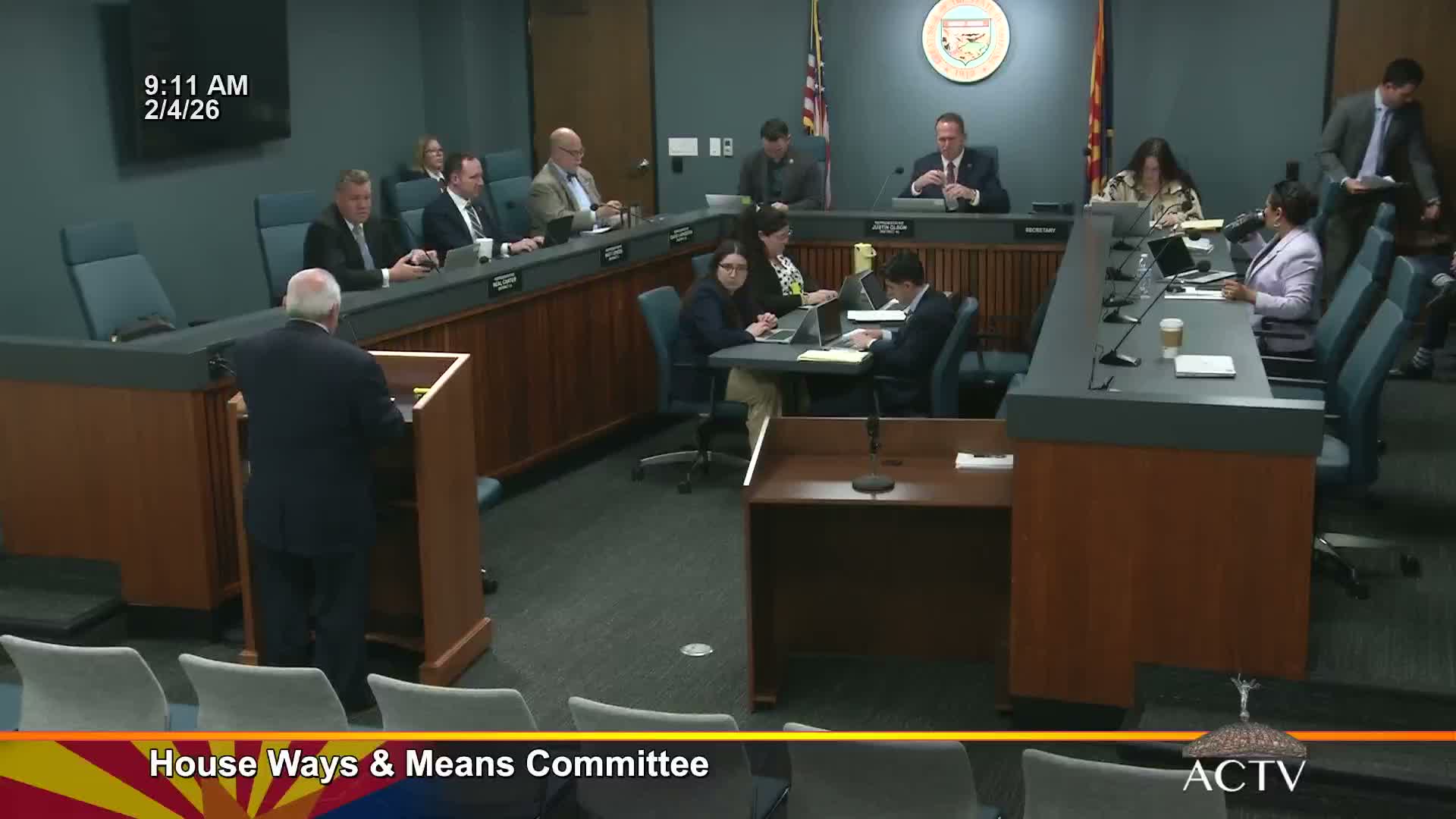
The Arizona House Ways and Means Committee on Feb. 4 returned House Bill 27‑85 with a due‑pass recommendation, 5 ayes to 4 nays, after a lengthy debate over whether the measure should lock in federal tax changes now or be considered as part of broader budget negotiations.
Supporters, including the bill sponsor, told the committee HB 27‑85 simply makes state statutes match the tax forms the Arizona Department of Revenue (DOR) already issued for tax year 2025 and argued the step is necessary to avoid forcing taxpayers to amend returns later. Vince Perez, a House ways and means research analyst, summarized the bill as conforming Arizona law to the Internal Revenue Code as of Jan. 1, 2026, adopting retroactive dates for 2025, adding individual income tax subtractions, and modifying deductions.
The sponsor said the measure will provide immediate certainty to filers who have used the DOR forms and estimated roughly $440,000,000 in tax relief for Arizona taxpayers. Provisions discussed on the floor that supporters pointed to include a larger standard deduction, a $6,000 senior deduction and provisions described in testimony as excluding tips and overtime from taxable income. Supporters and witnesses representing small businesses and tax‑policy groups argued that 100% expensing and other federal provisions drive investment and that failing to conform would impose compliance and administrative costs.
Opponents, including witnesses from Opportunity Arizona and the Arizona Center for Economic Progress, said the package locks in costly federal tax cuts that primarily benefit higher‑income filers and corporations. Joseph Palomino of the Arizona Center for Economic Progress told the committee the conformity package could cost an estimated $1,480,000,000 over fiscal years 2026–2029 (his figure for the multi‑year window), and Blake Lister of Opportunity Arizona said the SALT‑related provisions in the bill would disproportionately benefit wealthy filers and cost the state about $80,000,000 annually for that component alone. Members also noted other states have partially decoupled from the federal changes because of the size of the revenue impact.
Committee members questioned witnesses on revenue trends, pointing to differing analyses about how much recent revenue growth is explained by inflation, population growth, capital gains, corporate income and other factors. Several speakers also raised administrative costs: committee members recalled prior Department of Revenue testimony — not presented at this hearing — estimating that if the state did not adopt conformity and taxpayers had to refile, DOR could face about $20,000,000 in additional processing costs and that many taxpayers had already filed on DOR forms that assume conformity.
Legal and procedural tensions animated much of the debate. Supporters argued conformity traditionally precedes budgets and was needed to ensure filings already made under DOR guidance are legal; opponents said adopting the full package before a clear budget plan risks cuts to core services and urged negotiating the fiscal offsets before enacting permanent changes.
After discussion, the committee adopted an amendment and voted to return HB 27‑85 as amended with a due pass recommendation (5 ayes, 4 nays). The committee record shows members explained their votes on the floor before the secretary recorded the tally. The bill now moves to subsequent House floor proceedings per the legislative process.
The committee heard and cited specific figures and claims on both sides of the debate; where numbers were given in testimony, the article attributes them to the speakers who offered them. The Department of Revenue was referenced repeatedly but did not offer live testimony at this hearing; committee members relied on DOR figures from earlier committee appearances to estimate administrative costs.
What happens next: HB 27‑85 will proceed according to the House legislative calendar, with its due‑pass recommendation forwarded to the full House. If passed and signed, the bill would apply retroactively to tax year 2025 and align state law with the federal Internal Revenue Code as of Jan. 1, 2026.