Get Full Government Meeting Transcripts, Videos, & Alerts Forever!
Get email alerts on the Unemployment Insurance topic
No spam. Unsubscribe anytime.
Arizona committee advances bill tightening unemployment work‑search rules, cross‑checking claims
Summary
The Senate Government Committee voted to give SB 10‑36 a due‑pass recommendation after adopting a technical amendment. The bill would require five meaningful weekly work‑search actions, weekly cross‑checks of UI claims and new employer reporting and referral requirements; DES warned of implementation costs and increased appeals.
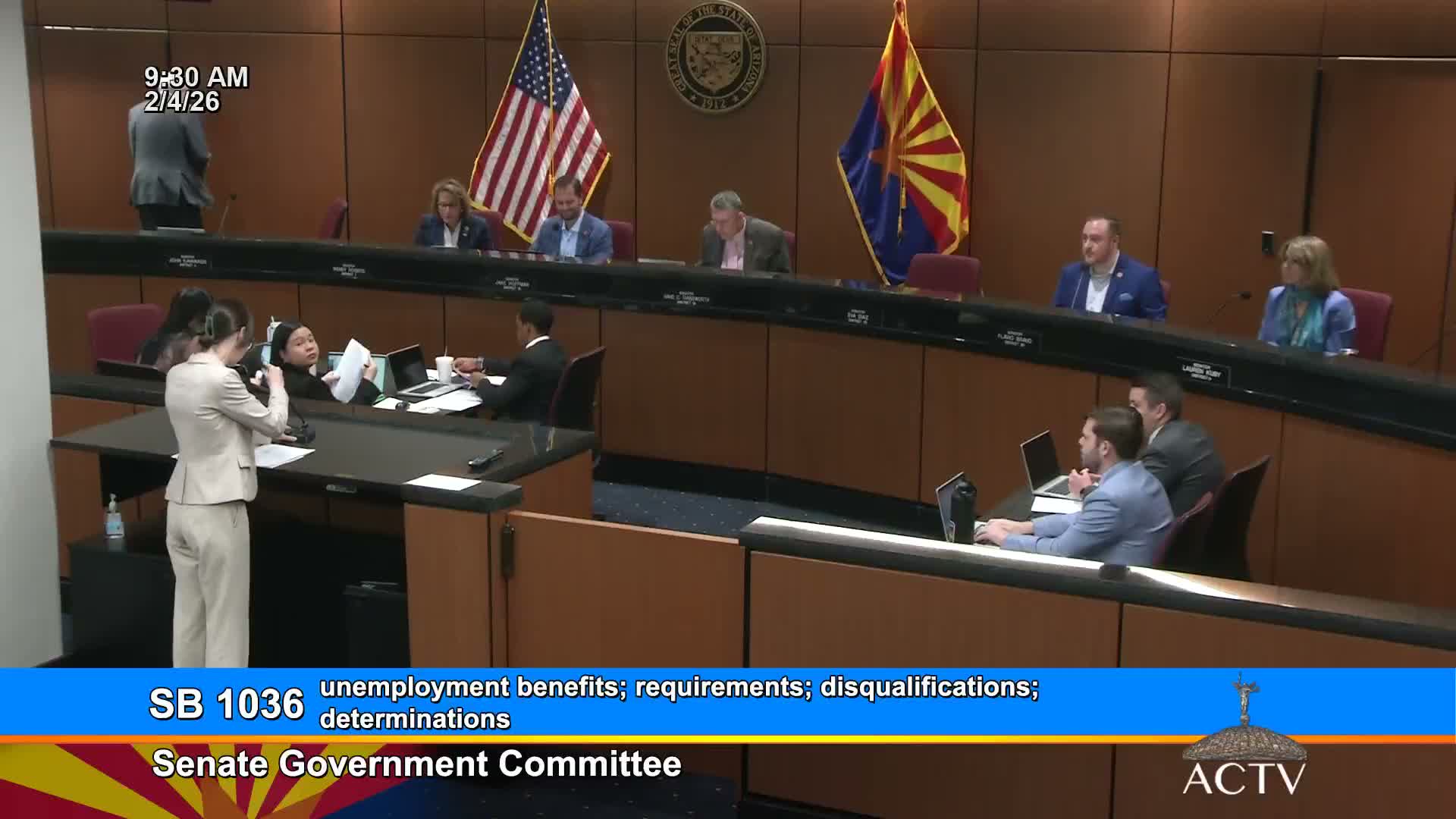
The Senate Government Committee on Feb. 3 moved SB 10‑36 toward passage after adopting a technical amendment and sending the bill out with a due‑pass recommendation.
Sponsor Senator David Finchem told the committee the bill is designed to protect taxpayer dollars and strengthen program integrity by requiring claimants to conduct at least five work‑search activities each week and by directing the Department of Economic Security (DES) to perform weekly cross‑checks of initial and ongoing unemployment insurance claims.
"There are some great cross reference softwares that are out there that are far below the amount of money that we are likely losing by not using them," Finchem said, arguing the proposal is primarily a risk‑management and fraud‑prevention measure.
Tim Pugliese of FGA Action, testifying in support, said the proposal would "require claimants to complete five meaningful activities like interviews, applications, or resume workshops" and asserted that fraud and overpayments totaled "$46,000,000 over the past three years." He urged the committee to adopt provisions that would connect claimants to work faster while protecting employer tax dollars.
Melanie Richards of the Arizona Department of Economic Security told the committee DES is neutral on the bill but cautioned the agency is still finalizing fiscal impact estimates. Richards said the legislation would require system programming changes, training, and increased adjudicative work and appeals because investigators would need to conduct individual reviews of employer reports and other matches. She warned the department does not have excess administrative funding and would need additional time and resources from its vendor to implement the new checks.
Committee members pressed DES on how the proposal would affect apprenticeship participants and on the expected fiscal impact; DES responded that many of the proposed checks are already in place but that the agency would need to verify applicability to apprenticeship schedules and supply an updated fiscal estimate before floor consideration.
After a period of questions and closing remarks by the sponsor, the committee adopted an eight‑page Hoffman technical amendment and voted to advance the bill. The committee roll call recorded a due‑pass recommendation by a vote of 4 ayes to 3 nays.
The committee also aired broader oversight concerns about DES readiness and budgets during the exchange. The chair criticized agency testimony that he said lacked basic, on‑hand data about fraud rates and noted the committee expects agencies to arrive prepared to provide fiscal and programmatic detail.
Next steps: SB 10‑36 will be scheduled for further floor consideration with the committee's due‑pass recommendation.