
Maryland Auto Insurance Fund projects tighter finances as policy counts fall; lawmakers weigh affordability and assessments
Get AI-powered insights, summaries, and transcripts
Sign Up Free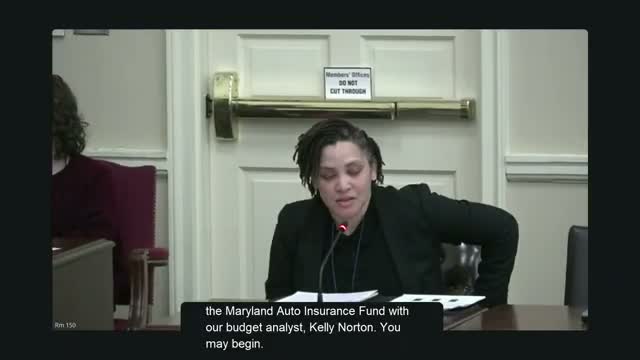
Summary
The Maryland Auto Insurance Fund told the House appropriations subcommittee that policy counts fell sharply after 2024, driving lower earned premiums and projected net losses even as the fund considers operational changes and a pilot six‑month policy term to reduce down payments.
The Maryland Auto Insurance Fund told the House Appropriations Committee’s Transportation and the Environment Subcommittee that it expects the fund’s operating budget to rise modestly to $36.5 million in calendar 2026 while continuing to face declining policy counts and material operating losses.
Budget analyst Kelly Norton told the subcommittee the 2026 budget is projected to increase 3.2% from 2025 and that the insured division will see the largest salary increases and IT contract costs. Norton said the insured division projects a net loss of about $14.3 million in 2025 and that a larger net loss is projected for 2026 absent changes.
Director Al Redmer said Maryland Auto was created ‘‘50 years ago to be the insurer of last resort’’ and described how pandemic-era market shifts and subsequent underwriting changes by private carriers doubled the residual market for a time and then led to a steep decline in policies as carriers returned to the private market. ‘‘We can’t proactively do anything to generate new business,’’ Redmer said, explaining the fund receives customers the private market will not insure.
Redmer defended the fund’s affordability focus and said the Maryland Insurance Administration issued an order in December 2024 directing Maryland Auto to modify its affordability approach and to be rate adequate by 2027. He told the committee the MIA ‘‘ordered us to do two things’’: move from a geography‑based affordability test to an individual policyholder approach and, ultimately, to eliminate affordability adjustments and achieve rate adequacy by 2027.
Maryland Auto estimates that in 2025 the average property damage claim was about $4,200 and that bodily injury claims averaged approximately $12,000. The fund said that a recent assessment equaled roughly $3 per $1,000 of premium and that future assessment needs are still being evaluated; Redmer said an assessment of roughly $14.9 million for 2026 had been discussed as a range estimate.
Committee members pressed Maryland Auto on the size of the uninsured population. Redmer said the fund receives weekly MVA lists identifying drivers newly uninsured for at least 60 days and that the list included roughly 68,000 names in 2025, a roughly 20% year‑over‑year increase, though he cautioned that not all entries reflect permanently uninsured individuals.
To retain customers and lower upfront costs, Maryland Auto said it is exploring operational and regulatory changes including treating renewals more like true renewals (rather than rewrites that require a new down payment), piloting a six‑month policy term to reduce down payments and encouraging more frequent shopping in the private market. Redmer said those steps are intended to improve affordability without raising rates on low‑income policyholders.
Lawmakers pressed whether affordability as an explicit mission would restore the fund’s surplus. ‘‘No,’’ Redmer said, noting the fund historically relied on an assessment mechanism created by the General Assembly and that absent a new funding mechanism the fund expects continued operating deficits.
The committee asked for updated certified financial statements; DLS had recommended committee narrative requesting such updates to allow ongoing monitoring.
The hearing did not include any formal votes or actions on legislation; lawmakers signaled broader policy decisions about affordability and assessments will be taken by the General Assembly this session.