Health Care Authority warns large budget requirement to cover Medicaid expansion, HR1 costs and rural health investments
Loading...
Summary
Oklahoma Health Care Authority officials told the Senate appropriations subcommittee their FY27 budget requirement is large and time-sensitive, driven by Medicaid expansion utilization, HR1 administrative changes and a planned rural health transformation push that will increase short-term utilization and require system investment.
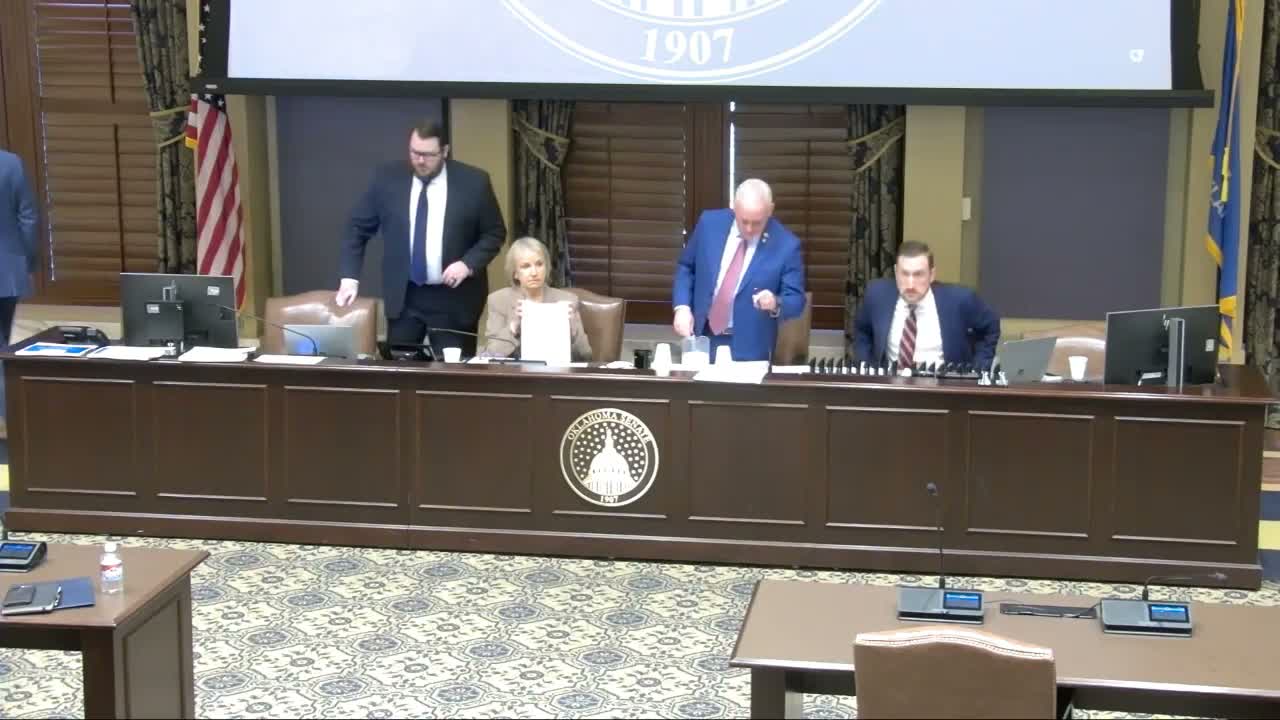
The Oklahoma Health Care Authority told the Senate Health and Human Services Subcommittee for Appropriations that its FY27 funding need is a budget requirement, not a discretionary ask, and that failing to fund it would force difficult cuts or emergency appropriations.
OHCA Secretary Clay Bullard said the agency is operating with thin cash reserves—about a five- to six-week window—and that while FY26 can be managed, FY27 will strain operations without additional appropriations. He and CFO Josh Richards emphasized that actuarial projections and utilization assumptions drive the request: each 1 percentage-point error in utilization forecasts equals roughly $20–$21 million in additional costs.
The request covers several categories: ongoing Medicaid expansion costs (estimated state share about $250 million of roughly $2.5 billion in total expansion spend), administrative and systems costs associated with implementing federal HR1 rules (including work requirements and six-month eligibility redeterminations), and a package tied to rural health transformation grants and investments. Melissa Miller, the agency’s State Medicaid Director, said the expansion population shows higher utilization now and that the agency expects expansion-related costs to continue rising in the near term.
Bullard described a $55.1 million systems and infrastructure line intended to build a statewide technical platform (including AI-assisted document ingestion) to implement HR1-driven work-verification and redetermination processes for hundreds of thousands of members. He said OHCA is contracting a vendor whose work will be shared with other state agencies to avoid duplication.
Bullard and Josh Richards defended recent moves toward value-based managed care, saying early results show some providers who engaged with the model have improved financial performance and outcome metrics; the agency monitors claim timeliness and requires plans to pay 95% of clean claims within 14 days and 99% within 90 days. Still, the agency acknowledged transition-related cash-flow pressures for some providers, and Bullard said some poorly prepared providers may exit networks while other providers and the MCOs have capacity to absorb patients.
The hearing also flagged a planned federal rural health transformation award (roughly $223 million awarded with the state estimating up to $400 million in funds flowing to rural providers over two rounds). OHCA predicted a near-term utilization increase from improved access and factored in an estimated $40 million of additional provider costs tied to that bolus.
Bullard concluded that if the Legislature chooses to fund some portion as one-time or supplemental money, the executive and appropriations leaders would need to negotiate how much becomes base funding going forward. He said the agency will provide detailed, line-item consequences of cuts and programs that could be reduced if full funding is not approved.
The committee asked OHCA to provide further data on managed-care payments since April 2024, claim-payment lags and the detailed actuarial assumptions behind the FY27 requirement. Bullard and staff committed to follow up with the requested documentation.