
Apache Junction council denies 300-unit downtown LIHTC apartment CUP amid traffic and infrastructure concerns
Get AI-powered insights, summaries, and transcripts
Subscribe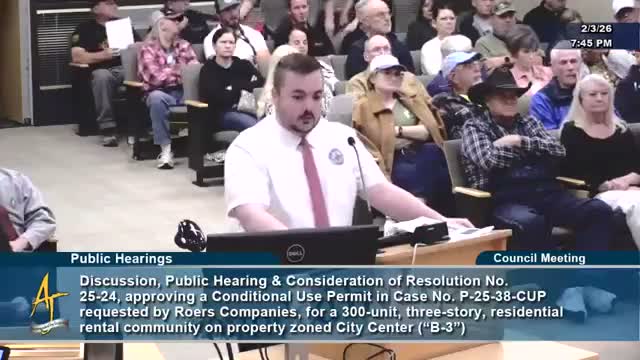
Summary
After more than three hours of presentations and public comment, the council voted 5-2 to deny a conditional use permit for Roar's Companies’ proposed 300-unit downtown LIHTC project, citing inadequate roadways, traffic safety on SR-88/Idaho Road and concerns about infrastructure and water.
APACHE JUNCTION, Ariz. — The Apache Junction City Council on Feb. 3 voted 5–2 to deny a conditional use permit for a proposed 300-unit multifamily development in the downtown mixed-use core, after a lengthy public hearing in which traffic, water and infrastructure capacity were repeatedly raised.
Planner Nick Leftwich introduced the Roar’s 88 Project (P2538 CUP), describing a 300-unit rental community at the Idaho and Scenic Street alignment in the B-3 City Center zone. The applicant proposed 670 parking spaces, covered parking with solar charging canopies, a clubhouse, pools, a dog park and a public multi-use trail that would integrate with the downtown trail network. Staff noted the applicant is not requesting zoning deviations and has revised elevations to respond to prior council feedback.
Greg Davis of iPlan Consulting presented for the applicant, Roar’s Companies, and explained the project’s anticipated use of Low-Income Housing Tax Credits (LIHTC). Davis described LIHTC as a developer-focused subsidy that requires long-term commitments (typically 15 years), annual tenant qualification rules and HUD-set rent limits based on the Phoenix metropolitan area. "This project gives you that livability of a market rate project but does so at a lower price," Davis said, explaining LIHTC aims to serve lower-middle-income households rather than the lowest-income residents.
Developer neighbor Carl Huish (Bella Flor Communities) urged council support, saying Roar's would add full-time downtown residents that could attract retail. "Let's get more full-time residents to downtown Apache Junction," Huish said.
Opponents raised traffic and infrastructure concerns. Multiple residents and business owners said Idaho Road (State Route 88) and nearby intersections are already stressed and questioned whether the project’s traffic analysis accounted for other nearby developments. "There's no infrastructure — fix your infrastructure before you build your city," resident David Day said, citing potential future demands on fire, police and roads. Other speakers warned of impacts to downtown character, water supply and long-term maintenance of LIHTC properties.
Council deliberations centered on the seven required findings for a CUP, including adequacy of roadways and public facilities and conformance with the general plan. Several council members said they were unable to find that roadways and public facilities could safely accommodate the proposed density, and emphasized that the city lacks control over SR-88/Idaho Road, which is managed by ADOT.
Council Member Johnson moved to deny the resolution associated with the CUP; the motion was seconded and passed on roll call: Council member Neser — No; Council member Johnson — Yes; Council member Cross — Yes; Council member Heck — No; Council member Soller — Yes; Vice Mayor Schroeder — Yes; Mayor Wilson — Yes. The motion to deny passed 5–2, thereby denying the CUP.
City staff and applicant had noted some negotiated conditions — including a dedicated on-site residential manager unit and revised elevations dated Jan. 20, 2026 — and Planning & Zoning Commission had recommended approval at its Oct. 28, 2025 meeting (transcript records a Planning & Zoning Commission vote reported as 4–1 in favor). Council members said the project otherwise met many technical requirements but that traffic and lack of local control of the state highway were decisive.
Mayor Wilson thanked the large turnout of residents for their engagement; the council then moved on to other business and adjourned.