Get Full Government Meeting Transcripts, Videos, & Alerts Forever!
Get email alerts on the Multilateralism topic
No spam. Unsubscribe anytime.
Ecuador urges stronger multilateral action on crime, migration, climate and UN reform
Summary
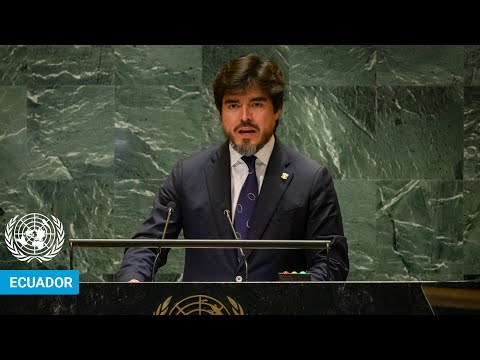
Jose de Legazca, head of Ecuador’s delegation, told the U.N. General Assembly Ecuador supports multilateral solutions to transnational crime, migration and climate-driven disasters, highlighted Ecuador’s Security Council role and called for a Latin American woman to be the next U.N. secretary‑general.
Jose de Legazca, head of Ecuador’s delegation, told the United Nations General Assembly that Ecuador is committed to multilateralism and to updating global institutions to meet contemporary challenges. "The United Nations Charter must remain our guiding light," he said, framing his country’s priorities around peace, human rights and sustainable development.
De Legazca opened by conveying the regards of Ecuador’s president, Daniel Noboa Assin, and described Ecuador as "a country of 18,000,000 inhabitants" where young people are driving demands for change. He said the government is pursuing transformational projects and a "firm commitment to root out corruption and impunity," linking stronger institutions to reductions in violence and improved economic opportunity.
On security, he described transnational organized crime and narcoterrorism as threats that "undermine institutionality," and said Ecuador has adopted "responsible decisions" to confront those problems while urging greater international cooperation because national resources alone are insufficient. He noted Ecuador’s recent elected membership on the U.N. Security Council and recalled the country’s participation in votes and co‑sponsorships, saying Ecuador has been "co‑penholders on the humanitarian file" for Ukraine and has voted in favor of Security Council resolutions aimed at halting hostilities and enabling humanitarian access in Palestine.
De Legazca highlighted regional stabilization efforts in Haiti, pointing to a multidimensional support mission for security that he said was adopted by "resolution 26 99 in October 2023" and was renewed through 2025. He also referenced a "historic resolution 27 19 or 2023" intended to open pathways for sustainable financing of missions mandated by the African Union.
Turning to migration, the Ecuadorian delegate tied the movement of people to human trafficking and smuggling networks and said the most vulnerable are unaccompanied children and women. He cited a regional displacement figure, saying "7,700,000 Venezuelans" have left that country seeking opportunities abroad, and called for "safe, orderly, and regular migration" that avoids criminalization and requires comprehensive, coordinated international responses.
On climate and biodiversity, De Legazca said Ecuador is suffering from its "worst drought in recent decades," warned of threats to fragile ecosystems including the Amazon, the Andes and the Galapagos Islands, and urged greater international finance, technology transfer and capacity building. He welcomed the entry into force of the BBNJ (biodiversity beyond national jurisdiction) agreement and flagged the UN Oceans Conference scheduled for 2025.
Ecuador also underscored its role in negotiating environmental instruments. De Legazca said the Ecuadorian presidency of the committee drafting a legally binding instrument to eliminate plastic pollution is pressing forward and expressed hope that the Galapagos Islands could host the instrument’s signature.
On institutional reform, he called for a "true transformation of global governance" and for a stronger General Assembly that can help enable Security Council reform. He concluded by saying crises can be overcome "with political decisions, willingness, and bravery" and reiterated Ecuador’s support for a woman from the Latin American and Caribbean region to be the next U.N. secretary‑general.
The speech combined policy items — security and migration responses, climate and biodiversity protections, and institutional reform — without proposing immediate, binding measures at the Assembly session; De Legazca emphasized Ecuador’s preference for coordinated international action and for implementing recently adopted agreements and declarations.