Get Full Government Meeting Transcripts, Videos, & Alerts Forever!
Get email alerts on the Property Tax topic
No spam. Unsubscribe anytime.
Bill to consolidate state school levies and expand senior property-tax relief draws mixed support
Summary
House Bill 2376 would merge two state school levies into a single levy, raise qualification thresholds for seniors/disabled/veterans, add a standard deduction for calculating disposable income, and change the statement labeling for the state school levy; Department of Revenue estimates tens of thousands of additional households would qualify while also projecting state revenue increases and a local revenue shift.
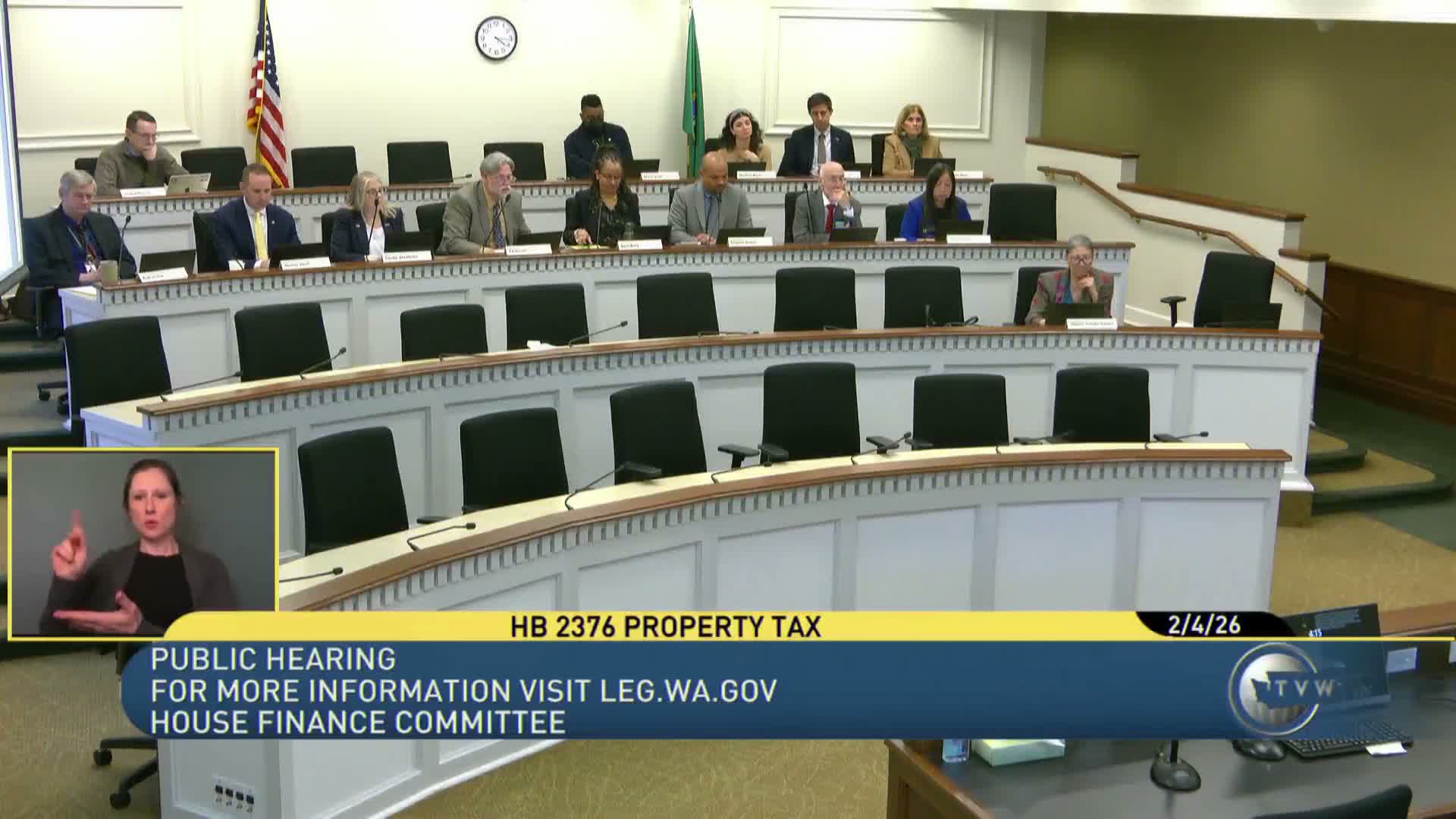
House Finance received a staff briefing and public testimony on House Bill 2376 on Feb. 4. Serena Dolly, staff to the committee, told members the bill would consolidate the state’s two school levies into a single levy and set a specified rate in the bill for calendar year 2027 (transcript wording: "$2 and 9 and a half cents per assessed value"). The measure would raise each program income threshold by 10 percentage points, increase the portion of a home's assessed value that may be exempted under the senior/disabled/veteran exemption program, and offer a standard deduction of $7,500 for claimants (plus an additional $7,500 for a spouse or domestic partner) as an alternative to itemizing deductions when calculating combined disposable income. The bill would also exclude combat-related special compensation from the disposable-income calculation and require each property tax statement to identify the state property tax as the state school levy.
Dolly reported Department of Revenue estimates that roughly 30,000 additional households would qualify for the partial exemption for seniors, people with disabilities and veterans; DOR estimated approximately $25 million in additional state revenue for fiscal year 2027 and $99 million in the following biennium, and described a projected tax shift affecting local revenues in the first year on the order of $60 million at the state level and a local revenue decrease the record characterized as approximately $8.6 million for local levies and a shift of roughly $134 million in the first year under the change.
Representative Sharon Wiley (49th District), the bill's prime sponsor, described the proposal as an incremental adjustment to ensure the property tax system better allows seniors to age in place and reduce burden, and said additional technical work was underway to reduce the size of the fiscal note. County assessors and county officials testified in support: Jennifer Wallace (Washington Association of County Officials) and Stephen Drew (Thurston County assessor) said the bill would simplify administration and expand access, and Peter Van Nortwick (Clark County assessor) supported raising thresholds but urged removal of a proposed $500,000 cap on the exemption amount to avoid unintended harm in high-value counties.
Public commenters voiced concerns that the bill could expand the tax base or lead to tax shifts that challenge voter-approved limits on property-tax increases. Remote testifiers raised fears about tax-shift impacts and called for broader, across-the-board relief instead of targeted changes. Committee members questioned staff and witnesses about the rate-setting mechanism and the fiscal note; Stephen Drew explained he understood a rate in the first year was necessary when funds are combined and that leadership aimed for a revenue-neutral initial rate.
The committee closed the public hearing on HB 2376; staff and sponsors indicated further technical work on rates and fiscal impacts was ongoing.