Get email alerts on the Portable Solar Codes topic
No spam. Unsubscribe anytime.
Experts brief committee on emerging standards for portable and plug‑in solar
Summary
PNNL experts told the committee that recent standards (including a newly published UL 3700) and NEC revisions provide a pathway for safe portable ('balcony') solar but that certified devices are not yet common and code updates follow multi‑year cycles.
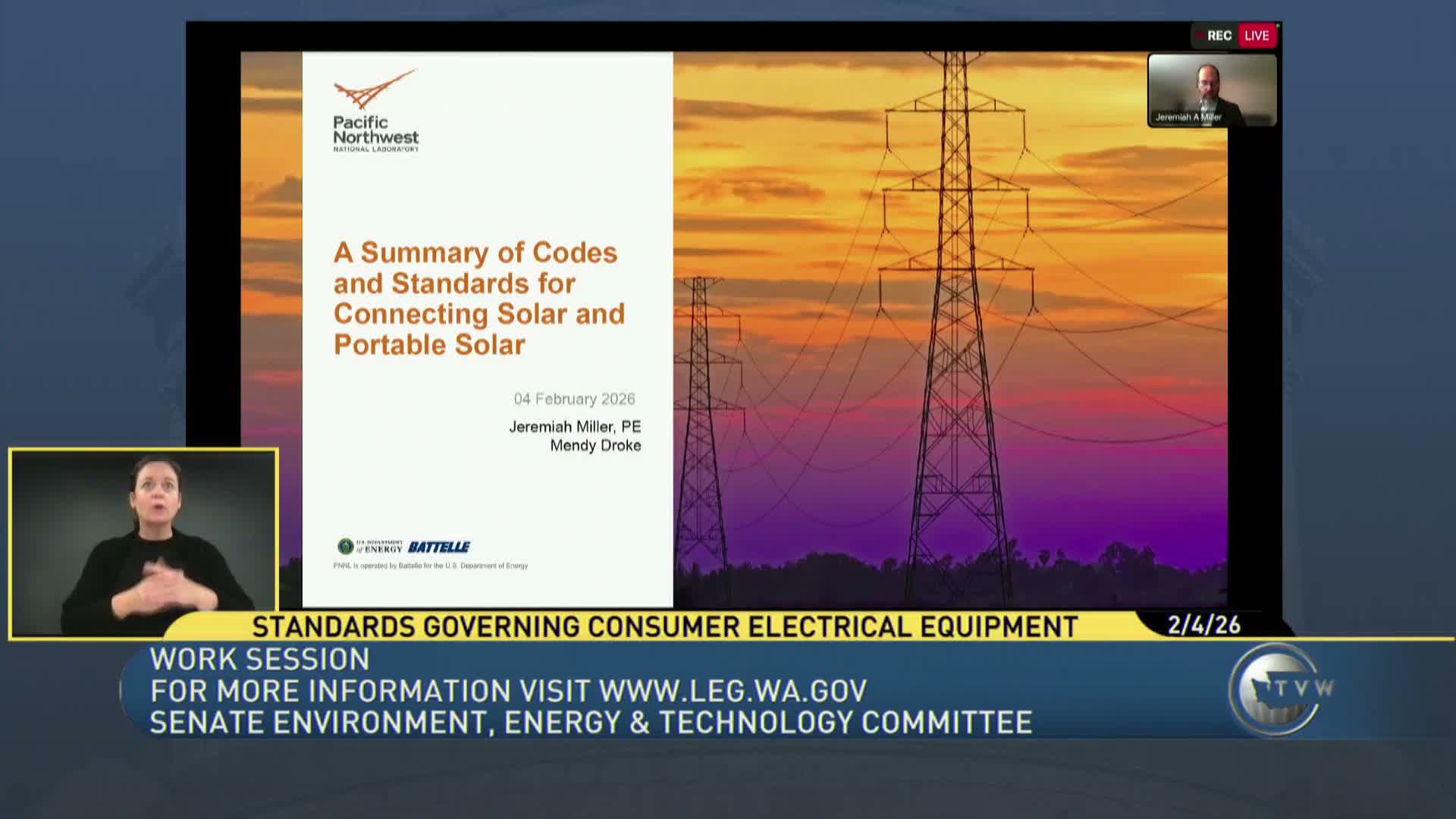
The Environment, Energy, and Technology Committee’s work session reviewed codes, standards and certification pathways for connecting portable and plug‑in solar systems to homes, businesses and the electric grid.
Jeremiah Miller of the Pacific Northwest National Laboratory said the safety and reliability regime for distributed energy resources stacks several standards: the National Electric Code (NEC) governs installation, UL standards (for example, UL 1741 and the newer UL 3141) provide product listing and testing, and IEEE 1547 governs how inverters and generating devices interact with the grid. Miller told the committee these codes and standards have evolved over decades and are periodically updated.
Miller highlighted a very recent certification, UL 3700, aimed at portable plug‑in solar systems commonly called balcony or plug-in solar. He said the standard had just been published and, to his knowledge, no manufacturers had completed formal certification yet, though certification typically takes a few months and now provides a path vendors can follow. "This one is more focused on the portable, solar systems... and this one tests and certifies that those systems meet the requirements around safety," he said.
Committee members pressed on timing and consumer safety. Miller explained that the NEC is updated on a three‑year cycle and that the NEC already includes mechanisms allowing listed and certified devices to be installed; where UL or supplemental standards are newer, regulators and stakeholders often rely on supplemental certifications until NEC language is formally updated.
Miller also warned about off‑market consumer devices available online that may not meet listed safety standards, and described liability and marketplace pressures that typically discourage major retailers from selling clearly unsafe equipment. He recommended legislative care in authorizing devices to ensure the law matches available certification and installation guidance.
The committee thanked the presenters and adjourned.
AI generated
The text on this page is AI generated. Summaries, highlights, analysis, and video transcripts are all produced from the original source material.
AI can make mistakes, so if you spot one, and we will fix it for everyone.
Note: the source content is unaltered by us. Any content source we link to, be it a video, an audio recording, or a document, is presented exactly as its publisher released it. That publisher is usually a government body, sometimes an individual official or another organisation.