
Committee hears competing views on textile needs-assessment substitute in SB 6,174
Get AI-powered insights, summaries, and transcripts
Sign Up Free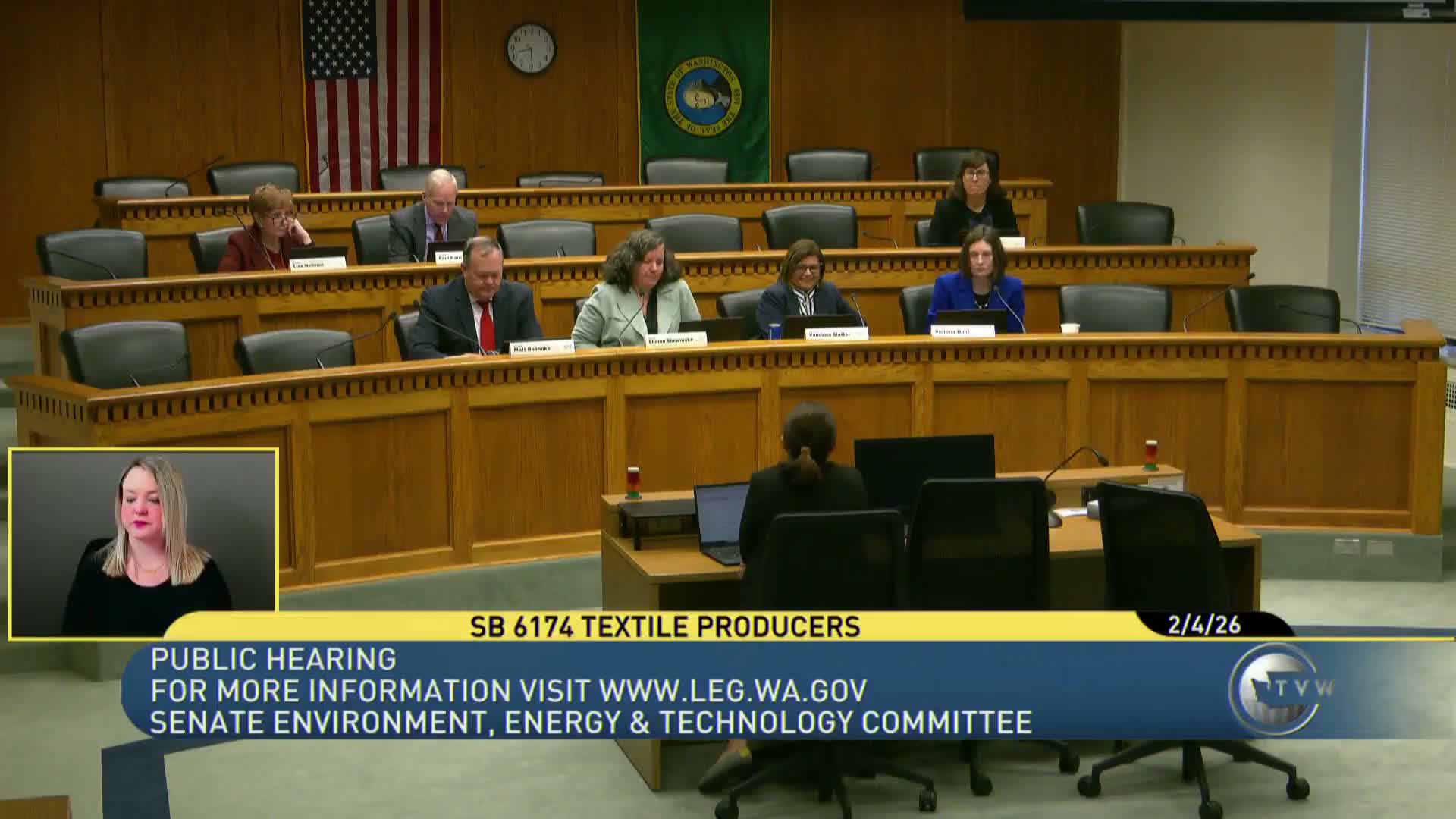
Summary
The committee heard testimony supporting a needs assessment for textile producer responsibility and opposing testimony that the substitute presumes an outcome and could overburden retailers; witnesses urged further stakeholdering and clarity on definitions and enforcement.
Senate Bill 6,174 (proposed substitute) — a textile extended-producer-responsibility measure limited to a needs assessment in its current substitute form — drew both municipal support and industry caution at a committee hearing.
Alicia Kinney Clausen briefed the committee on key dates: by Jan. 31, 2027 each covered-product producer must appoint a textile and apparel coordinating organization (TACO); Ecology must approve an eligible TACO by March 15, 2027; producers must be TACO members by June 1, 2027; and the TACO must submit a needs assessment to Ecology by March 2028 and to the Legislature by September 2028. The needs assessment is intended to inform budgets, quantifiable performance standards and a plan for any future EPR program.
Supporters urged action to address the growing textile waste stream. McKenna Morrigan of Seattle Public Utilities said textiles are a fast‑growing part of the waste stream and urged industry collaboration to advance reuse, repair and recycling infrastructure; Dar Breuling, a Lake Washington High School student, testified in favor citing Ecology figures on large annual textile tonnages.
Retail and industry witnesses urged caution. Crystal Leatherman (Washington Retail Association) and Peter Godlewski (Association of Washington Business) supported a needs assessment but warned that the substitute contains enforcement elements that could presume an EPR outcome or shift liability onto retailers. Andrew Pappas (American Apparel and Footwear Association) also urged more time to learn from California’s experience before standing up a statewide program.
Several witnesses flagged drafting concerns: Jessica Franken (SMART) said the bill references “recycling” repeatedly without defining it and may undervalue proved collection systems such as clothing bins; Carrie Dolan reiterated hospitality-sector concerns that company uniforms — often purchased by employers and not sold to consumers — could be treated as a covered product and impose burdens on small businesses.
Chair closed public testimony after recording sign‑in totals. The substitute was presented as a limited needs-assessment step, but witnesses from business and trade groups emphasized ongoing negotiation would be needed to resolve definitions, fee responsibilities and enforcement mechanisms before advancing any full EPR program.