Get Full Government Meeting Transcripts, Videos, & Alerts Forever!
Get email alerts on the Public Safety Complex topic
No spam. Unsubscribe anytime.
Temple Terrace council reviews $50 million public-safety bond for new police station, possible fire station
Summary
City staff presented conceptual designs and top-end costs for a new 33,000 sq ft police station and a possible 10,000 sq ft fire station on a 5-acre site at 7911 Harney Road; council signaled support for pursuing a general obligation bond on the primary ballot and asked staff to bring a referendum ordinance for formal action.
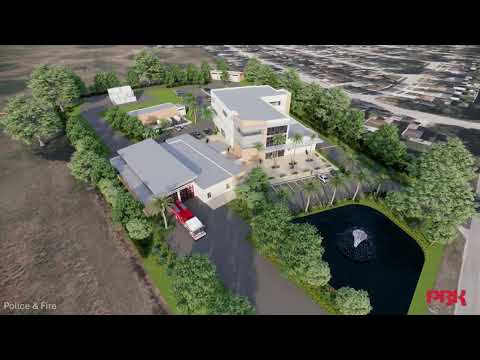
City of Temple Terrace officials on Feb. 3 reviewed conceptual designs, cost estimates and financing options for a proposed public safety complex on a 5-acre parcel the city bought in 2024 at 7911 Harney Road.
City Manager (speaking at the work session) said the site, bought with Rollison Ranch sales proceeds for $1,600,000, could host either a police-only facility or a joint police and fire complex. ‘‘We are here today to discuss the public safety complex,’’ the City Manager told council as he opened the presentation.
The architects engaged for the project (PBK) provided two concepts: a police-only station of about 33,000 square feet with secure fleet parking and an indoor firing range, and a joint-site plan that adds a one-story, roughly 10,000-square-foot fire station with two apparatus bays and shared training and conference space.
Staff presented top-end cost estimates prepared from three cost estimators. For the police station, construction cost was listed at about $31,000,000, plus soft costs ($2,600,000) and furniture/fixtures/equipment (~$1,000,000), yielding a top-end estimate of roughly $34,600,000. The fire station’s top-end estimate was about $10,700,000 (including ~$9,700,000 in construction, ~$824,500 in soft costs and ~$200,000 in FFE). To provide cushion for inflation and underwriting costs, staff recommended a not-to-exceed bond figure of $50,000,000.
On operational implications, staff said the police department remains in a limited 11,000-square-foot footprint on the third floor of City Hall while sworn staff have grown from 26 officers in 1982 to 57 officers today. Fire-service data in the council packet showed a 90th-percentile response time in the proposed Station 3 area at about 8 minutes 29 seconds versus a benchmark of 6 minutes 40 seconds; staff warned that without a new station that 90th-percentile figure could rise to 10–12 minutes by 2035. ‘‘8 minutes and 29 seconds is not meeting that benchmark,’’ the City Manager said while summarizing the fire department’s analysis.
As an interim operational step, staff said the department could move one existing rescue ambulance to the new site with current personnel, providing coverage without immediately hiring new firefighters. Full suppression staffing later would likely require adding up to 12 firefighter-paramedics; staff estimated that addition at roughly $1,300,000 annually based on current salary assumptions.
To finance construction, staff recommended a voter-approved general obligation (G.O.) bond, explaining that a G.O. bond is backed by the municipality’s taxing power and would appear as a separate millage dedicated to bond repayment. Using a 30-year bond as an example, staff presented illustrative interest-rate scenarios between 4% and 4.75% and projected a first-year millage of roughly 0.90 to 0.98 mills. Under that example, staff projected the annual tax impact for a $250,000 assessed home at about $225–$245 per year.
Bond counsel on the call (identified during the meeting as Mr. Rhodes) explained typical bond-issue mechanics, including limits on prepayment during an early call period and structuring options that can permit early payoff if certain grant revenues materialize. Staff also noted potential grant resources such as SAFER grants for firefighter staffing, which can offset a substantial share of early-year personnel costs under some federal grant structures.
Council members asked questions about timing, outreach and annexation. Several members — including the Vice Mayor and Council members Chambers and Kravitz — voiced support for funding both buildings together and placing the referendum on the primary ballot, citing the risk that a crowded general-election ballot could dilute attention. Council discussed the legal and logistical deadlines for ballot placement and the supervisor of elections’ translation requirement for ballot language.
No formal bond ordinance or referendum was adopted during the work session. Staff requested council direction on scope (police-only vs. joint) and ballot timing so staff could prepare a referendum ordinance for the upcoming council meeting. The City Manager said that, if approved by council, ordinance readings and submission timelines would put a primary ballot option on a compressed schedule and that construction would realistically begin in 2028 with occupancy around 2030.
The council discussion closed with general direction in favor of pursuing a G.O. bond for both facilities on the primary ballot and with staff agreeing to bring the formal referral ordinance for action at the council meeting later that evening.