Get email alerts on the Land Use topic
No spam. Unsubscribe anytime.
Chino Valley planning commission approves Perkins Ranch rezoning and conditional use permit for private airfield
Summary
After extended public discussion on noise, water rights and monitoring, the Planning and Zoning Commission voted 5–2 to approve a rezoning of about 390 acres for Perkins Ranch and a conditional use permit to allow a privately owned airfield with phased buildout and operational limits.
The Chino Valley Planning and Zoning Commission voted 5–2 on Feb. 3 to approve a zoning change and a conditional use permit that will allow Perkins Ranch to build a privately owned airfield and associated uses on roughly 390 acres east of Perkinsville Road and Forest Service Road 318A.
The commission approved ZC 2025-03 (rezoning the cited acreage from single-family residential 2-acre minimum to agricultural residential AR‑36) and CUP 2025-05 (a conditional use permit for an airfield) following a multi-hour staff presentation, technical briefings from the applicant and public questioning. Commissioner (speaker 3) moved to approve the zoning change and the CUP; both motions were seconded. Roll-call votes for both items recorded five affirmative votes (Commissioners Stotts, Morabito, Metters, Vice Chair Pesiak and Chair Merritt) and two dissenting votes (Commissioners Ditta and Zamudio).
Why it matters: The approvals allow Perkins Ranch Inc. to construct and operate a phased airfield intended to keep thousands of acres in long-term family ownership while permitting limited aviation-related development. Supporters argued the project will broaden the town’s tax base and create longer-term economic opportunities; opponents raised concerns about noise, environmental effects and long-range implications for rural character.
What was approved and conditions: Staff and the applicant described a multi-phase development that preserves the bulk of the Perkins property as open ranchland while concentrating airfield infrastructure on the rezoned parcel. Key elements discussed in the hearing and included in the record were:
- Runway length and phasing: Phase 1 was described as a 5,000-foot runway with the potential to build to 6,000 feet if financially feasible in a later phase; the development agreement and CUP conditions were refined to explicitly reference taxiway, apron and tie‑down elements omitted from the earlier draft and to require later phases to commence within 10 years of completion of phase 1.
- Operations and numerical limits: Staff and the applicant agreed to use the term “touch and go” (a single landing plus immediate takeoff) rather than a generic “operations” definition. The record cites an upper-limit framework of up to 40 touch-and-go events per hour, up to 110 per day, which the applicant said reduces the request to roughly 40,000 touch-and-go maneuvers per year (part of an 80,000-maneuver annual request when counting single maneuvers). The applicant explained the 40-per-hour figure using circuit math (one aircraft can perform roughly 10 touch-and-goes per hour; up to four aircraft in the traffic pattern yields ~40 per hour).
- Monitoring and accountability: The applicant committed to monthly ADS‑B data downloads and staff reporting for the first year, moving to quarterly reporting thereafter, and to a staff contact for monthly flight‑ops coordination to address complaints and potential mitigation.
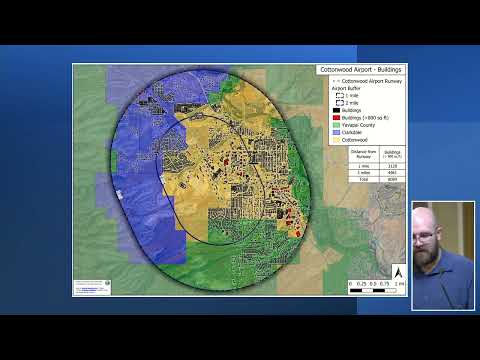
- Airspace and noise mitigation: The project team provided a flight‑pattern map and said alignments were adjusted to avoid flight paths directly over Chino Valley population centers, discussed routes along Granite Creek and described adherence to FAA airspace rules (Class D/E/G distinctions) and FAR minimum altitude guidance (applicants cited a 1,000-foot AGL requirement over built-up areas).
- Water rights: Chair Merritt and other commissioners pressed the applicant about water rights granted at annexation. Applicant Thomas D. Perkins said his family would negotiate a partnership with the town to address aquifer protection and the practical value of the annexation-related rights, but he declined to unilaterally surrender all water rights; Perkins said those rights are tied to the land and that the family prefers a negotiated approach.
Points of dispute and public concerns: Opponents questioned noise impacts, the long-term growth implications of rezoning, potential increases in aircraft activity if pilots 'made up' missed training days, and environmental concerns including lead in legacy avgas. The applicant pointed to FAA and Embry–Riddle coordination, ADS‑B tracking for verification, and phased design to limit development footprint.
Vote and next steps: The commission forwarded its recommendation to the Town Council; staff indicated the Town Council public hearing is scheduled for Feb. 23 (Grace Church) with Council deliberation Feb. 24 at Town Hall. The commission explicitly left room for negotiating specific CUP conditions (for example, attaching water-rights terms to the CUP if the commission and applicant agree).
AI generated
The text on this page is AI generated. Summaries, highlights, and analysis are all produced from the original source material.
AI can make mistakes, so if you spot one, and we will fix it for everyone.
Note: the source content is unaltered by us. Any content source we link to, be it a video, an audio recording, a transcript, or a document, is presented exactly as its publisher released it. That publisher is usually a government body, sometimes an individual official or another organisation.