Get Full Government Meeting Transcripts, Videos, & Alerts Forever!
Get email alerts on the District Budget Projection topic
No spam. Unsubscribe anytime.
Budget committee flags special-education revenue shortfall, recommends protecting $1.3M and approves hiring
Summary
At its Feb. 2 meeting, the Waunakee Community School District Budget Committee reviewed 2025–26 projections that show a likely $100K–$250K special-education revenue shortfall, recommended protecting $1.3M including a $1.1M IRS rebate, and approved posting five new positions to support capacity needs.
The Waunakee Community School District Budget Committee met Feb. 2 and was told the district faces an uncertain state reimbursement for high-cost special education that could leave the 2025–26 budget roughly $100,000–$250,000 short.
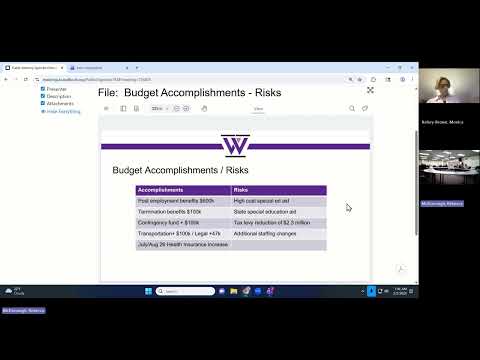
Speaker 2, who presented the year-end projection to the committee, said the district is "22,000 to the good" on post-employment benefits but is now estimating it will be "about 50,000 short" on termination benefits because a larger-than-expected number of administrative staff are retiring. On state special-education aid, Speaker 2 said the district had budgeted for a 40% reimbursement while the state indicated 50%, and current expectations put effective reimbursement "in the thirties," producing the projected shortfall.
Speaker 2 also told the committee that an IRS rebate of $1,100,000 has been deposited into the 2025–26 fiscal year and recommended the committee set an end-of-year fund-balance target that would preserve that rebate and at least $100,000 in contingency, "about $1,300,000" in total, to give the district fiscal flexibility.
The committee heard a broader financial-plan briefing tied to possible referendum choices for a new high school. Speaker 2 said the district's advisers have presented four planning elements: refinancing a prior $2.3 million levy reduction, issuing roughly $95 million in debt for a high-school project (figures still being priced), budgeting $2.1 million per year for four years in operational expenses tied to the project, and initially not using larger IRS clean-energy rebates in the package. Under the scenario presented, Speaker 2 said the combined capital and operational referenda would raise the tax rate by about "43¢, which is $43 per $100,000." The committee scheduled discussion of the high-school plan for the Feb. 19 meeting and was told the precise debt amount and tax-rate impact could change as pricing and planning continue.
On staffing, the committee was asked to recommend authorization for hiring so the district's recruitment can proceed. Speaker 2 outlined that, with the 4K planning changes and projected enrollments, adding two middle-school FTE, two custodians and one security position would be prudent. Speaker 4 moved to add five FTE; the committee voted in favor and authorized staff to post the positions for the February regular board meeting.
The committee asked staff to return with a clear fund-balance target and comparative-district expenditure data; staff said they would calculate an exact end-of-year target for the next budget meeting and that a Baird vendor workshop scheduled for Feb. 12 will help with district comparisons.
Next steps: staff will refine the five-year financial projections to reflect any changes in state special-education aid negotiations and present a final recommendation to the full board at the regular February meeting and follow-ups in March/April.