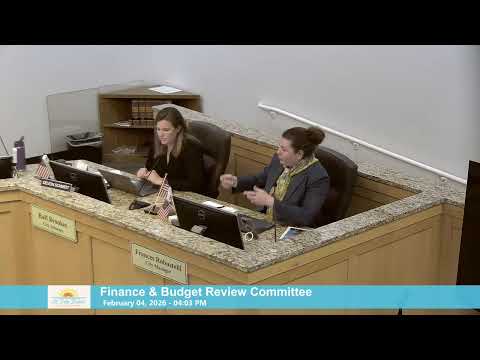
Staff warns state 'house bills' could cut St. Pete Beach property tax revenue by millions; committee discusses a menu of local revenue options
Loading...
Summary
Staff estimated the fiscal effect of several pending state proposals: a full homestead exemption could leave the city about $4 million short; senior exemptions roughly $3 million; a 25% assessed‑value cut about $1 million; and other proposals could cost the city millions. The committee discussed fees, assessments, bonds, and partnerships as potential responses and asked staff for detailed modeling.
City staff told the Review Committee they are tracking several state legislative proposals that could materially reduce local ad valorem (property tax) revenue and pressed the committee to consider a range of local revenue responses.
Devin Schmidt, the city’s finance director, said ad valorem taxes provide about 40% of the city’s general fund and outlined several scenarios staff is monitoring: a full homestead exemption would create roughly a $4,000,000 deficit for St. Pete Beach; expansive senior exemptions would be about a $3,000,000 impact; a 25% assessed‑value exemption was estimated at about $1,000,000; and property‑insurance relief proposals were estimated to reduce revenue by about $2,000,000. Staff discussed a portability provision (a reduction in taxable value portability caps) and noted the transcripted figure for that item was unclear and should be treated as approximate until staff provides a written estimate.
Staff framed those potential losses against core public‑safety commitments: each of the bills under discussion, as described by staff, would preserve funding for law enforcement and fire/EMS, thereby shifting the fiscal pressure to other services.
To offset potential losses and to address a separate list of capital needs staff estimated at $213,000,000, the committee discussed a menu of local revenue tools: fee studies and enterprise fund adjustments (parking, wastewater, stormwater, reclaimed water), holiday and boat‑ramp fee changes, property‑transfer taxes or local surcharges, fire‑assessment fees, community redevelopment tools, donations and naming rights, public‑private partnerships and targeted assessments, bond issuance, and piloting a commercial parking assessment. Staff said the University of Florida law students are studying the legal viability of some approaches, including tolls and road ownership transfer, and that some ideas (commercial parking assessments) have not been used in Florida before.
Board members asked staff to produce more precise modeling: the committee requested end‑of‑year revenue figures for 2025 to be republished on the city website, project‑by‑project cost estimates for the capital list, and the per‑resident cost of any proposed bond or assessment. Staff committed to returning with those analyses and to publish the capital‑projects dashboard and scoring outputs for commissioner and public review.
The committee closed by reiterating priorities: focus on near‑term deliverables and a phased approach to the $213 million need while pursuing creative revenue options and maintaining transparency with residents.