
St. Pete Beach staff propose multiple parking fee changes to raise revenue; commissioners approve package minus card surcharge
Get AI-powered insights, summaries, and transcripts
Subscribe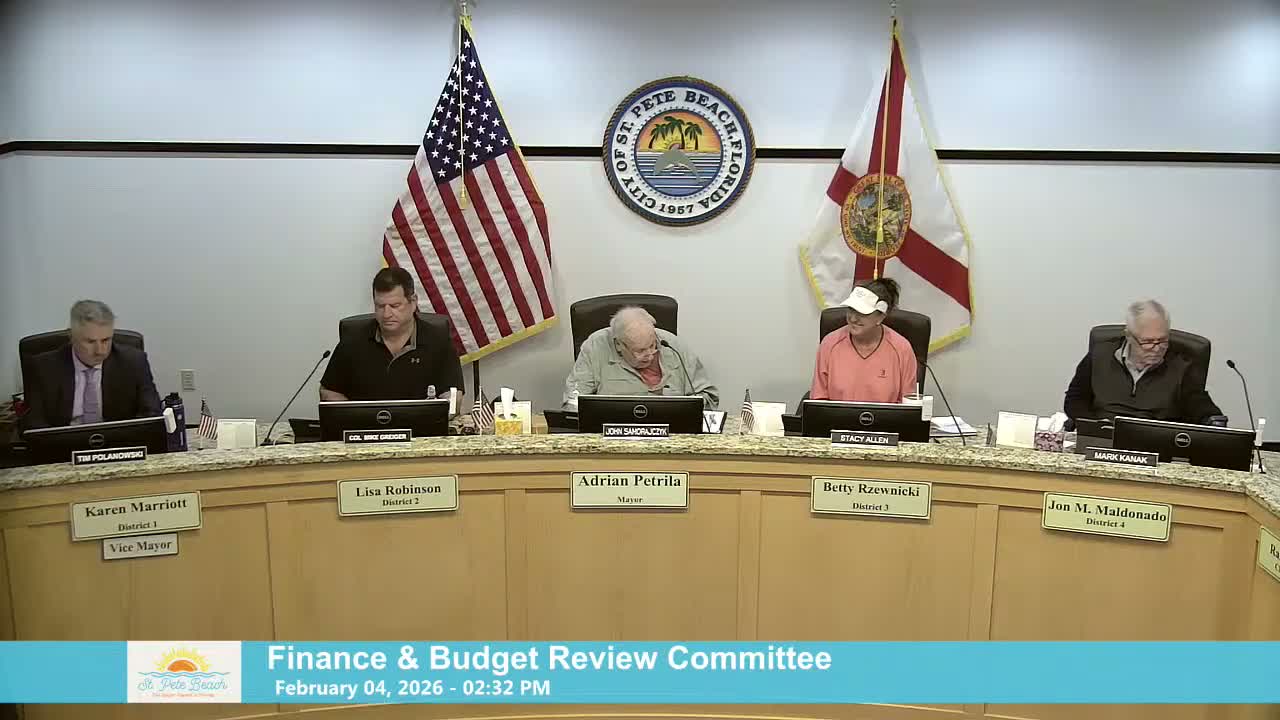
Summary
City staff proposed changes to parking pricing — including time‑of‑day and seasonal surcharges, aligning county-park rates with city rates, and reclassifying Fridays — that staff estimate could raise hundreds of thousands annually. The board approved moving the package forward but excluded passing through a 3% credit‑card fee.
City staff outlined a series of parking price changes intended to boost local revenues and help fund infrastructure needs.
Kathleen Murray, who said she works in the city manager’s office, told the Review Committee that annual metered sales in St. Pete Beach are about $6,000,000 and the average parking transaction is $8.67. She presented a menu of options: pass through the 3% credit‑card fee to customers (staff estimated this would amount to roughly $160,000 a year, given current average transactions), add a "sunset" premium between 4 p.m. and 8 p.m. (estimated roughly $280,000 annually if raised by $1/hour), adopt a seasonal surcharge (staff estimated about $475,000 for a $1/hour addition Feb. 1–April 30), treat Fridays as weekend rates (staff estimated about $200,000), and align the county park rate with the city's rate (staff said eliminating the county‑park discount could net the city about $300,000 per year, recognizing the county and city currently split county‑park revenue 50/50).
Murray described operational levers and trade‑offs: lowering off‑peak rates could reduce revenue (staff estimated a broad morning discount would cost about $582,000 annually), while targeted surcharges and rate harmonization would preserve turnover that benefits local businesses. She noted the city has an enterprise fund for parking to track revenues and expenditures, and that any parking improvements or technology purchases should be financed from that fund.
On implementation, staff cautioned that advanced demand‑based pricing requires new technology. One staff member said a competitive RFP and procurement process would likely take about 18 months to procure license‑plate readers or a platform that can manage dynamic pricing. Staff also said the city receives monthly reports from ParkMobile (and similar vendors) and that both ParkMobile and FlowBird were recently acquired by a company named Arrive; the vendors’ differing update schedules were cited as an operational challenge.
After discussion — including concerns about signage clarity and impacts on residents who rely on short errands — the committee voted in favor of moving forward with the proposed rate increases while excluding the 3% credit‑card surcharge. A motion to adopt that recommendation was seconded and approved by voice vote.
The committee asked staff to provide more granular revenue breakdowns (for example, the combined effect of implementing all options and separate figures for holiday or boat‑ramp changes) prior to the commission presentation. Staff indicated they will return with those calculations and the timing for an RFP so commissioners can review implementation timing ahead of high season.
The committee’s next step is for staff to refine the revenue estimates, finalize legal and fee‑schedule language, and present the package to the city commission.