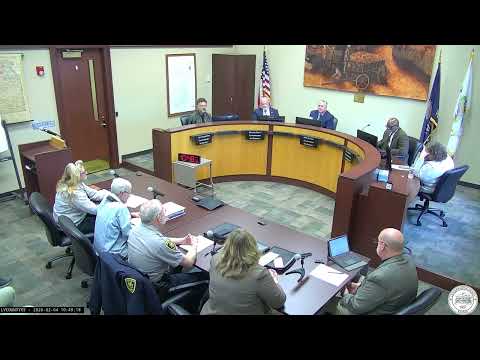
Leavenworth County reviews draft consolidating decades of animal rules, asks staff to refine language
Loading...
Summary
Commissioners reviewed a staff-drafted resolution compiling older county animal rules and debated enforcement, overlaps with state and federal law, and whether to keep farm animal 'at large', exotic-animal and 'vicious dog' provisions; staff and stakeholders will refine the draft and report back in about 30 days.
Leavenworth County commissioners on Monday reviewed a staff-prepared draft resolution that compiles several county animal-related measures dating to 1978, and asked staff and local stakeholders to return with a narrowed, enforceable version in roughly 30 days.
Misty, who presented the draft, said she manually compiled older county resolutions including a 1978 "animals at large" resolution covering farm animals, a 1995 authorization vesting certain stray-animal response with the sheriff's office, a comprehensive October 2001 exotic-animal regulation and a 2006 vicious-dog resolution. "What I have included in here is a very rough draft of a resolution," Misty said as she outlined the effort to verify whether previous measures remain in force.
Commissioners and agency representatives focused discussion on two practical questions: what the county should regulate directly and what is already handled by state or federal authorities. A sheriff's office representative, describing enforcement experience, said many older ordinances had "no teeth" because the county lacked an active codes court for years and that broad local enforcement could be expensive and difficult. "I've been with the sheriff's office 26 years," the representative said, adding that seizing and housing many animals or administrating a large increase in 'vicious dog' designations would create an administrative burden.
A veterinarian who participated urged aligning local language with existing Kansas law and regulatory definitions so the county does not create conflicts with state standards or the Kansas Veterinary Practice Act. "Cruelty is cruelty. I may not be able to define it, but I certainly recognize it when I see it," the veterinarian said, while recommending relying on statutory language "consistent with" state law to give the county appropriate enforcement authority without duplicating state or federal regulations.
County staff warned against repeating state and federal regulatory language verbatim in local code because higher-level rules change and duplication risks inconsistency. Staff advised removing provisions already covered by K.S.A. sections, Kansas veterinary rules or USDA authority and focusing county policy on areas the county can reasonably and sustainably enforce.
The draft's broad definition of "vicious dog" drew particular concern. Speakers said the proposed language could convert many routine bites—such as delivery workers entering yards or a child pulling a dog's tail—into newly defined 'vicious' cases, triggering requirements such as registration and costly insurance for owners. One participant noted internal inconsistencies in the draft (for example, holding periods and euthanasia timelines) that should be harmonized.
After discussion, commissioners directed staff and the group of stakeholders present to collaborate on narrowed language and to return to the commission with recommended edits and enforceability analysis. The board asked for a follow-up report in about 30 days to provide broader direction on whether to retain, repeal or significantly revise provisions governing animals at large, exotic animals and vicious-dog procedures.
The meeting closed after the chair thanked the Humane Society and other participants for attending. No formal votes or ordinance adoptions were taken at the session.