Get Full Government Meeting Transcripts, Videos, & Alerts Forever!
Get email alerts on the Committee Roundup topic
No spam. Unsubscribe anytime.
Senate General Laws & Technology Committee advances housing, AI, data‑privacy and consumer protection measures, holds others for study
Summary
The Senate committee reported several housing and consumer bills to Finance, carried over an AI disclosure/liability bill for additional fiscal analysis, and paused a rental‑fee measure for stakeholder work. Key debates included AI liability (SB365), reclaimed‑water requirements for data centers (SB417), rental fee limits (SB349) and social media data portability (SB85).
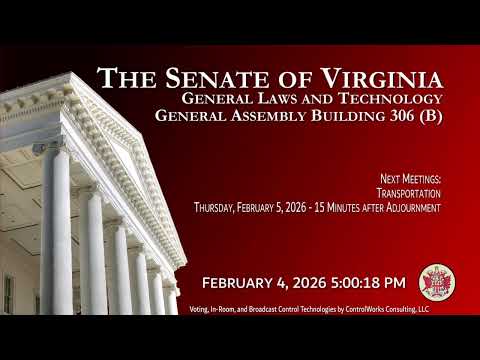
The Senate General Laws and Technology Committee met in Richmond to consider a wide docket of bills covering housing, consumer protections, technology and administrative reforms. Committee members reported multiple bills to Finance, carried others for additional study, and postponed several measures after extended testimony from industry groups and advocates.
Chair (unnamed) opened the session and handled preliminary housekeeping, then the housing subcommittee presented a package of proposals the panel recommended advancing. The committee voted to report SB5 (an income‑qualified energy efficiency and weatherization task force) and refer it to Finance with the committee substitute adopted on a 14‑0 roll (reported by the housing subcommittee). Committee members described the task force as a tool for DHCD, the Department of Energy and DSS to identify barriers to enrollment in existing efficiency programs.
AI regulation and liability: Senator Pokarski’s SB365 drew the meeting’s most contested debate. The bill would require disclosures about base AI models, create a private cause of action for people or property injured by AI systems, and prevent developers from using AI as an absolute liability shield. Michelle McGregor of the American Innovators Network told the committee, “we believe this bill gets it right by striking a balance between consumer protections and safeguards and supporting critical innovation” (testimony in support). Trade groups opposed the approach: Patrick Hedger of NetChoice argued the bill “misplaces liability, holding the creator of a tool liable rather than the misuse,” and Brianna January of Chamber of Progress said disclosure rules risk exposing trade secrets. After discussion the committee agreed to carry SB365 over and send letters to the relevant agencies (including a request for fiscal and technical information to Jay Cox and DHCD) so members can review BEED/other funding impacts before further action.
Water and data centers: Senator Stewart’s bill (and related amendments to SB417) proposing phased reclaimed‑water requirements for data center cooling prompted detailed testimony. Stewart described the proposal as a phased approach starting in 2027 with the stated aim of reducing aquifer withdrawals; he said, “by 2031, you would have to all be on reclaimed water” for applicants to the grant program. Maria Saab, representing Amazon Web Services, told the committee AWS already uses reclaimed water at many Virginia sites but that reclaimed‑water treatment and distribution is not available in every locality. Fairfax Water’s Jamie Hedges supported an amendment that excluded the Occoquan Reservoir—Senate members adopted that amendment and asked DEQ, VEDP and local partners for additional study and coordination before a final vote.
Rental fees and tenant protections: The committee considered a narrowed substitute for SB349 that would cap application fees at actual out‑of‑pocket costs, limit the set of fees landlords can charge at move‑in or renewal, and require clearer disclosure of fees before an applicant tours a unit. Tenant advocates said upfront and “junk” fees push low‑income households toward eviction; Larissa Zehr of Legal Aid Justice Center described examples where administrative fees inflated move‑in costs for families. Industry groups including the Realtors and apartment associations raised operational concerns and requested technical fixes. The committee elected to carry the bill for one week to give sponsors and stakeholders time to resolve technical points.
Data portability and platform competition: SB85, a bill encouraging portability and voluntary interoperability for social platforms (modeled in part on legislation enacted elsewhere), was debated and its substitute adopted with a commitment to refine definitions (for example, metadata). Supporters said portability can reduce lock‑in and empower users; opponents warned about cybersecurity and consent risks. The committee reported the substitute with unanimous support and plans for continued technical work.
Other notable actions: the committee reported a slate of consumer‑protection and technical bills (including a solar contract disclosure bill, SB823, and several housing bills) to Finance. It adopted technical substitutes for professional licensure updates (for CPAs) and modernizing agency fee processes (DPOR fees). Proposals that were explicitly passed by indefinitely included a measure to limit bulk single‑family home acquisitions by covered entities (SB547) after a 3‑3 subcommittee split, and SB830 (a resolution on historic place names) after contested testimony about foreign‑policy implications.
What’s next: Several bills were advanced to the Senate Finance Committee for budget and fiscal review; bills that were carried or set aside—most notably SB365 (AI) and SB349 (rental fees)—will return after the sponsors gather additional technical, fiscal or stakeholder information. The committee adjourned after recording final votes and referred items as noted above.
Ending: Committee actions were procedural and many measures were technical; the most consequential outstanding items for follow‑up are the AI liability/disclosure bill (SB365), the reclaimed‑water provisions tied to data‑center incentives, and the rental‑fee reform work between advocates and industry. The chair closed the session and the broadcast concluded.