
Tucson outlines Safe City approach as partners report declines in gun violence at target sites
Get AI-powered insights, summaries, and transcripts
Sign Up Free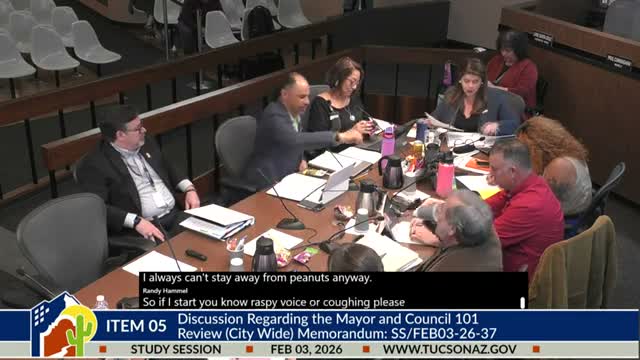
Summary
City staff outlined Safe City, a coordinated prevention–intervention–enforcement framework; partners reported up to 80% reductions in targeted ‘VIVA’ sites, a high conviction rate (86%) in gun cases, and 1,825 crime guns recovered, while staff announced a hospital‑linked intervention with Goodwill and noted legislative work on firearm destruction and regulation.
The City of Tucson on Feb. 3 presented the first of recurring Safe City initiative updates focused on gun‑violence prevention, intervention and targeted enforcement.
Assistant City Manager Liz Morales said the initiative aligns prevention, intervention and enforcement across departments and community partners to reduce fragmentation and improve deployments. Oscar Medina, the city’s newly hired violence‑prevention and intervention manager, described a multi‑year 2026–2030 roadmap and said the approach will be data‑driven and evidence‑based.
Tucson Police Department Assistant Chief Diana Duffy described operational changes that include centralized non‑fatal shooting investigations, an expanded regional gun‑crime intelligence unit (from 12 to 24 participating agencies) and weekly multi‑partner case review meetings. Duffy said the city has seen measurable results at VIVA sites: in one area an 80% reduction in violent crime in the first two years and sustained reductions thereafter. She also reported improvements in non‑fatal shooting solve rates (from roughly 20% to 84% in 2025) and a 19.5% reduction in gun homicides in 2025.
The city highlighted a hospital‑linked violence‑intervention partnership with Goodwill of Southern Arizona and Banner University Medical Center — a program that begins bedside contact with gunshot and stab victims and refers them to wraparound services. Banner and Goodwill reported 638 referrals in the first 18 months; Goodwill staff said they have enrolled higher‑risk participants in services, de‑escalated retaliatory incidents and connected people to education, workforce training, behavioral health and housing navigation.
Staff also previewed a public gun‑crime dashboard built with Everytown for Gun Safety that includes victim/offender demographics and incident mapping to guide deployments and policy. Laura Dent, director of state and federal relations, reported multiple bills at the state legislature that would change local authority on seized firearms and related regulation; staff will monitor and inform council as bills move.
Council members praised cross‑sector partnerships and asked staff to deliver more details on partnerships with schools and program outcomes. Staff said they will return with additional data and recommended next steps.
Next steps: continued quarterly updates to council, refinement of the Safe City roadmap and follow‑up reporting on outcomes and partnership expansion.