Get Full Government Meeting Transcripts, Videos, & Alerts Forever!
Get email alerts on the Housing Adus topic
No spam. Unsubscribe anytime.
Staff hearing officer approves three ADUs at 44–46 Ocean View Avenue with recorded parking easement
Summary
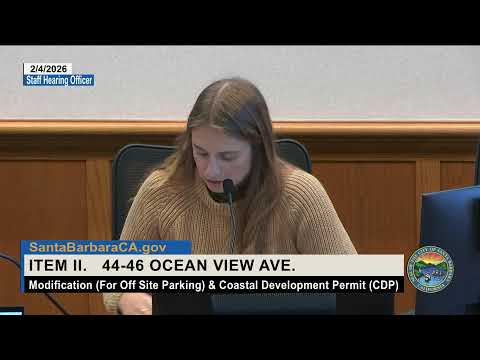
Staff Hearing Officer Tess Harris approved a modification and Coastal Development Permit on Feb. 4, 2026, allowing one ADU at 44 Ocean View Avenue and two ADUs at 46 Ocean View Avenue, contingent on a recorded covenant of easement to preserve required parking; the decision may be appealed to the Planning Commission within 10 calendar days.
Santa Barbara Staff Hearing Officer Tess Harris on Feb. 4 approved a parking modification and a Coastal Development Permit to allow three accessory dwelling units (ADUs) across two adjacent parcels at 44 and 46 Ocean View Avenue, provided a covenant of easement is recorded to preserve off-site parking access.
Harris said the modification "is consistent with the zoning ordinance" after staff concluded the proposal meets overall parking demand without removing existing units. The approved scope replaces a three-car carport at 44 with a single‑story ADU and adds two attached single‑story ADUs at 46, with a total parking reconfiguration to meet coastal-zone replacement requirements.
The decision follows a staff presentation by Pilar Plummer, associate planner with the City of Santa Barbara Planning and Zoning Division, who told the hearing officer that "accessory dwelling units... are not equivalent to additional density" and explained why the project triggers a coastal development permit and a parking modification. Plummer said the two lots are jointly owned, share driveway access and that staff supported locating some of 46's required parking on the adjacent 44 parcel if a recorded easement ensures long‑term access.
Plummer described site constraints — steep topography, narrow 50‑foot lots and a 20‑foot driveway — and the height limits that apply to "special ADUs" on multiunit lots, which are generally capped at 18 feet. Because the parcels are in the coastal zone, the applicant must replace existing on‑site parking when constructing ADUs; staff reported 46 must provide seven spaces (five existing plus two new) and 44 must provide four spaces (three existing plus one new). The modification permits some required spaces for 46 to be located on 44 with an easement recorded as a condition of approval.
Plummer also told the hearing that staff identified as‑built, unpermitted work on the properties (decks and an addition) that are not part of the ADU review; those elements will require a separate planning application and an enforcement case.
Harris asked staff to clarify permanence of the parking arrangement in the event of a sale. Plummer said a condition requires that "a covenant of easement shall be processed and recorded such that if either parcel is granted separate ownership, access for vehicles and pedestrians to off‑site parking is maintained," meaning the recorded easement stays with the property regardless of ownership changes.
The staff report contained a minor correction to parcel references that Harris directed be fixed, and staff recommended removing a condition tied to new construction timing (condition D.1) because the ADUs involved are existing or being permitted under AB 2533 and related state provisions. Harris agreed to the correction and the suggested edit to conditions of approval.
Harris made findings that the modification is consistent with the zoning ordinance, that the project meets parking demand overall, and that the project is exempt from further environmental review under CEQA Section 15303 (new construction or conversion of small structures). She announced the modification and the Coastal Development Permit approvals and closed the hearing.
The approval may be appealed to the Planning Commission within 10 calendar days of Feb. 4, 2026. If the decision is appealed, a Planning Commission member may also suspend the hearing officer's decision during that period.