Get Full Government Meeting Transcripts, Videos, & Alerts Forever!
Get email alerts on the Homelessness And Opioid Crisis topic
No spam. Unsubscribe anytime.
Pima County and Tucson Leaders Agree to Joint Workgroups to Tackle Homelessness, Fentanyl Crisis
Summary
At a Nov. 18 joint meeting, Pima County supervisors and Tucson city council members reviewed county and city investments in housing, justice and public-health programs, discussed data-sharing and treatment gaps, and directed four staff workgroups to deliver recommendations in December; the county had adopted a regional '1 Pima' plan earlier in the day by a 4–1 vote.
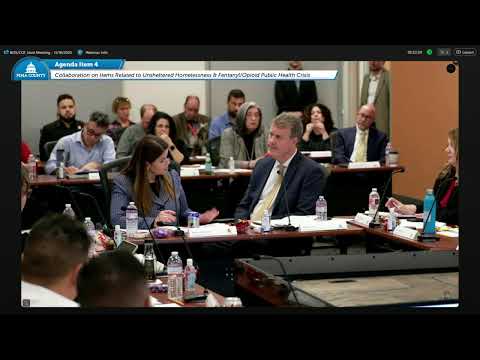
Pima County supervisors and Tucson city council members met jointly on Tuesday, Nov. 18, to lay out coordinated steps addressing unsheltered homelessness, gaps in affordable housing and a sharp rise in opioid and fentanyl harms across the region.
Deputy County Administrator Steve Holmes told the gathering the county has emphasized prevention in housing policy and has prioritized a set of programs to keep people housed and out of jail. "We started...gap funding about three to four years ago where the board wanted us to prioritize $5,000,000 a year" to help close financing gaps for affordable developers, Holmes said. He also described a supervisor proposal to phase in a tax intended to create a fund of about $250,000,000 over 10 years to support housing investments.
Holmes outlined other county investments, including roughly $10,000,000 in a program to help people facing eviction, a Craycroft transitional property the county manages that staff said has about a 91% transition rate into more permanent housing, and pretrial and transition-center reforms. "By standing up the transition center, we've seen [recidivism] reduced to under 10 percent," Holmes said, citing the county's internal outcome data for misdemeanor offenders who engage with the center. He also described a $3,000,000 investment in medical-assisted-treatment (MAT) services inside the jail, which county staff said has coincided with a drop in jail overdoses.
On the legislative front, Holmes noted there is currently no Arizona statutory authority to involuntarily hold people whose crisis is driven primarily by substance use disorder; staff referenced a prior proposal (identified in the presentation as SB 1257) that did not pass and said the county attorney's office is reviewing options.
Assistant City Manager Morales and other city staff presented the city's Safe City initiative and recent work under Mayor Mary Romero, saying the city has used American Rescue Plan and other funds to buy and renovate shelter properties and to expand outreach, embedded crisis-call takers in 911/311 and multidisciplinary outreach teams that provide on-site medical assessments and navigation. Morales said the city has spent about $21,000,000 in ARPA dollars on shelter-related investments.
Both staffs flagged persistent operational gaps: limited cloud/data sharing and integration, delays in authorizations that block timely access to residential treatment beds, cultural and linguistic barriers and transportation barriers between intake points and treatment. City and county staff pointed to recent analyses (a city gaps analysis circulated Feb. 2025, a county needs assessment, and sequential intercept mapping) and urged better data coordination to make resources visible and accountable.
Elected officials from both bodies voiced broad support for a coordinated approach while emphasizing different priorities: Supervisor Cano described the county's "1 Pima" regional framework and told the group the board had approved that plan earlier in the day by a 4–1 vote; she said 1 Pima would accelerate wash-and-trail cleanups, expand the transition center from five to seven days of operation, pilot a "safer center" for substance-use recovery and invest in neighborhood reinvestment on the West Side.
Other elected officials pressed for urgency and complementary approaches: Supervisor Allen framed three buckets—harm reduction, reweaving a safety net and upstream prosperity—while Supervisor Christie emphasized stronger enforcement against criminality in encampments. Councilmember Perez recounted a personal loss to fentanyl and urged better public communication about services. Councilmember Lee asked staff to report back on a $1,000,000 data-lake pilot and suggested the joint body adopt measurable shared goals.
Officials directed staff to form four Metro Justice workgroups—focused on data-sharing across systems, repeat offenders, strengthened partnerships with state/regional behavioral-health providers and diversion/deflection models—and asked those groups to return recommendations in December. Chair Sarah Scott and Mayor Mary Romero said the bodies will meet quarterly to track progress and asked for a joint memo to answer outstanding operational questions.
What happened and what comes next: the County Board of Supervisors adopted the county's 1 Pima framework earlier the same day (recorded in the meeting packet as a 4–1 vote); the joint meeting resulted in a staff directive to populate the four workgroups, pursue improved data integration and deliver a set of December recommendations to elected officials. Staff and elected leaders repeatedly stressed the mix of prevention, treatment and enforcement measures necessary to move people off the streets into stable housing and care.
The meeting concluded with agreement to continue quarterly joint convenings and to task staff with producing more precise metrics and a joint memo answering questions raised during the discussion.