
Bill to curb Legionnaires disease wins broad technical support but utilities warn of costs
Get AI-powered insights, summaries, and transcripts
Sign Up Free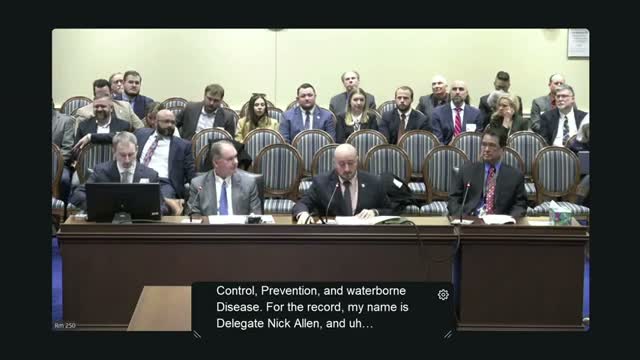
Summary
HB 204 would require minimum disinfectant residuals in public water distribution systems, mandated monitoring and ASHRAE‑188‑based building water‑management plans; public‑health experts and building owners backed the approach but utilities and building groups raised concerns about scope, testing capacity and potential treatment costs.
Delegate Nick Allen told the Environment and Transportation Committee that HB 204 is a technical, science‑based response to a rise in Legionnaires disease in Maryland and nationwide. "Legionnaires disease is now widely recognized as the deadliest waterborne disease in the United States," Allen said, adding that many cases are sporadic and tied to low disinfectant residuals or system disruptions.
The bill would require public water systems to maintain minimum disinfectant residuals across distribution systems, notify customers of distribution disruptions, and require covered buildings to implement water‑management programs referencing ASHRAE Standard 188. Dr. Hong Chung (Johns Hopkins/Perelman School of Medicine) and other public‑health witnesses supported the bill as a way to reduce outbreaks and deaths, noting that building and distribution controls are complementary.
Supporters said the measure is modeled on recent laws elsewhere (including New Jersey) and ordinary practices already used by many large hospitals and housing operators. Jason Stepp of Enterprise Community Partners said increased chlorine residuals correlated with reduced Legionella test positivity in his organization’s mitigation efforts at a property that previously experienced an outbreak.
Water utilities and building industry groups supported the bill’s goals but urged changes that would narrow or phase implementation. Opponents cautioned that a prescriptive numeric standard and expanded building obligations could require substantial new treatment infrastructure, increase disinfection‑byproduct (DBP) risk in some systems and exceed current laboratory/testing capacity; they recommended giving the Maryland Department of the Environment rulemaking authority to set numeric limits after technical review.
The sponsor and allies signaled willingness to work on amendments, including targeting covered buildings and giving MDE and MDH roles to avoid duplicate responsibilities while preserving the bill’s prevention focus.