
TVUSD advisory committee outlines bond options to replace aging portables, estimates $117M minimum to unlock state match
Get AI-powered insights, summaries, and transcripts
Sign Up Free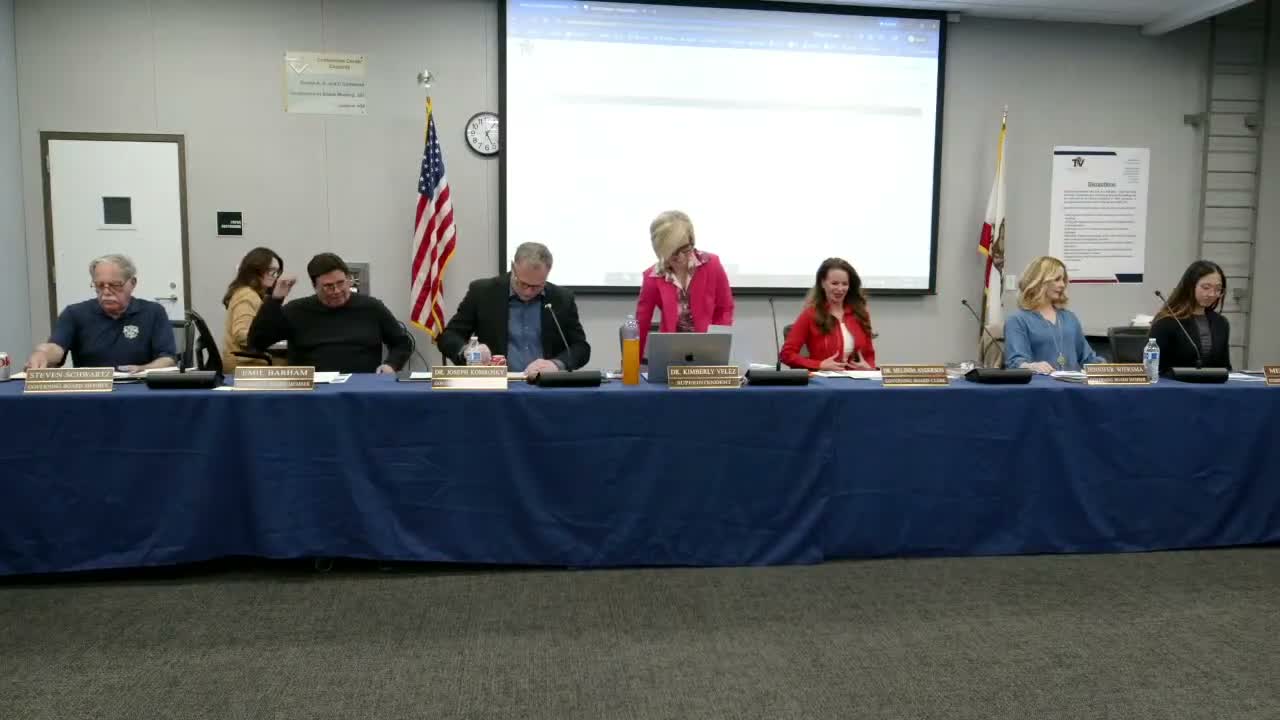
Summary
A TVUSD board advisory committee presented options for addressing aging facilities, including replacing about 350 portable classrooms and pursuing a voter-approved bond to unlock an estimated $70 million in state matching funds; the committee stressed fiscal prudence, transparency and staged project phasing.
Temecula Valley Unified School District trustees on Feb. 4 heard an informational update from a board advisory committee that laid out options to modernize aging school facilities and described parameters for a potential local bond measure.
The advisory committee said Measure Y funds have been exhausted and that the district faces large modernization needs — including about 350 portable classrooms averaging 28 years old — but that it will narrow a $1.8 billion master plan to a bare-bones, safety-first list if the board decides to pursue a bond. "We do not have a final recommendation to this board about what specifics or parameters around a bond initiative that we want to propose," committee member Jack Guerrero told trustees, adding that the group is focusing on safety and fiscal prudence.
Why it matters: Committee members argued that a local bond could unlock state matching dollars created by Proposition 2 (2024), but only if the district fronts the local share and meets eligibility rules. The committee estimated roughly $70,000,000 in potential state match for eligible projects and calculated that the district would need to spend at least about $117,000,000 locally to qualify for that match. Committee members and staff stressed the match is reimbursed by the state after project completion and is not immediate or guaranteed.
Committee findings and numbers: Presenters said 22 district schools will reach a 30-year modernization threshold within six years and that a comprehensive facility master plan identifies about $1.8 billion in needs — a starting point the committee said it will refine to essential projects only. Jack Guerrero summarized the funding calculus: "If you do the math, that means that we would have to spend at minimally a $117,000,000 to qualify for the $70,000,000 match." District staff cautioned that receiving state match requires completing projects, submitting them for reimbursement and waiting in a statewide queue.
Voices from the presentation: Committee member Jeanette Chung described what committee members saw on site visits to portables: "There was a very distinct odor to many of them that caused great concern to me personally... I could not believe what we were walking into." District staff member Nicole Lash explained the state process: projects are reimbursed "in order of submission," and while a district keeps its place in line it must still wait for state bond sales and allocations. Community member Josh Shirlink, speaking during public comment, urged careful stewardship of taxpayer dollars: "I care about what my tax is due... I really hope everybody here is able to participate at a very mature level."
Budget options and tradeoffs: Committee presenters set out four funding buckets — school impact (developer) fees, the district general fund, state matching funds, and local voter-approved bonds — and discussed scenarios that combine them. The committee noted an audited general-fund ending balance of about $145,000,000 as of June 30, 2025 but emphasized that not all of that balance is available for construction because some funds are restricted and the district faces multi-year operating deficits. The committee also described modeling examples that show how an incremental tax of $15–$30 per $100,000 of assessed value would translate into hundreds of millions in bond proceeds.
Oversight and next steps: The committee reiterated commitments to Proposition 39/39-style transparency and citizen oversight. If the board moves forward it would be required to establish a citizens' oversight committee and to provide project lists and annual, separate audits of bond proceeds tied to ballot language. The committee proposed a timeline: another community survey in March, committee recommendation to the board in April, a board decision in May on whether to place a measure on the ballot, and finalization of ballot language in June.
What the board did: Trustees took no final action on policy or a bond tonight; the board voted to receive the advisory committee's update 5-0. The committee will return with further analysis, project lists and recommended bond sizing if the board requests further work.
The board adjourned at 6:58 p.m.