
Senate Energy Committee advances OWRB-led water package citing $24 billion need
Get AI-powered insights, summaries, and transcripts
Subscribe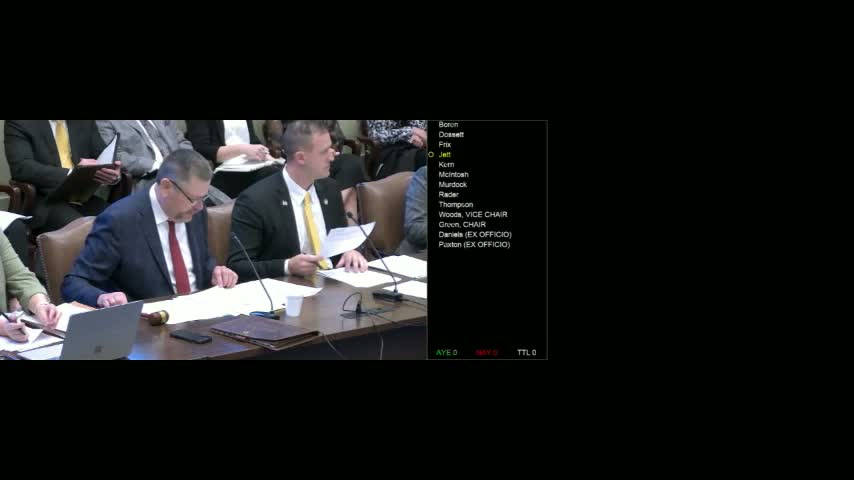
Summary
The Oklahoma Senate Energy Committee advanced legislation aimed at centering water infrastructure in the appropriations process and creating loan and grant programs modeled on an Oklahoma Water Resources Board request, citing an estimated $24 billion statewide need through 2030.
Senator Hall told the Senate Energy Committee he introduced Senate Bill 13 33 to "put water front and center" in the appropriations process, citing the Oklahoma comprehensive water plan’s estimate of about $24,000,000,000 in statewide water-infrastructure needs through 2030. He said the measure is intended to provide a public, legislative vehicle to combine multiple water-related bills into a single Senate package and to coordinate with authors and OWRB on funding priorities.
The measure mirrors parts of the Oklahoma Water Resources Board’s budget request, Hall said, and he asked the committee to allow the bill to move so he can negotiate appropriations and strike the appropriation language later. Hall described the OWRB request as a $50,000,000 recurring ask broken down in the agency’s submission: $10,000,000 for the REAP water grant program, $5,000,000 for technical assistance and regional planning and outreach, $25,000,000 for a low-interest revolving loan fund, and $10,000,000 for a state infrastructure development grant program.
Senators pressed for details about prioritization and urgency. Senator Board asked whether the OWRB maintains prioritized lists for projects; Hall replied that OWRB does keep such prioritizations and that funding would follow those priorities. Board also asked whether an "emergency clause" was justified; Hall pointed back to the $24 billion estimate and pressed for a long-term, recurring approach to funding.
OWRB Director Julie Cunningham later testified during related bills that the spacing and permitting proposals and programmatic requests grew from the 2025 comprehensive water plan, a statutorily required 50-year plan updated every 10 years. Cunningham told senators the spacing and program changes are aimed at protecting existing commercial water-right holders and ensuring the board can apply consistent spacing rules across basins, not just in those with completed maximum-annual-yield studies.
Committee members from both rural and metropolitan districts described repeated outages and failing systems in small towns and urged swift action. After discussion, the committee recorded a roll-call vote that advanced Senate Bill 13 33 out of committee by an 11-0 vote.
What’s next: The author told the committee he intends to take the bill into appropriations and work with other authors to assemble a comprehensive water package; the OWRB-directed program bill (SB 13 46) was also advanced by the committee and may be folded into broader deliberations on funding and structure.