Get Full Government Meeting Transcripts, Videos, & Alerts Forever!
Get email alerts on the Land Use Midtown Row topic
No spam. Unsubscribe anytime.
Williamsburg council approves special‑use permit to convert Midtown Row retail into five apartments
Summary
After a lengthy public hearing, the City Council approved PCR 24‑022 to convert 8,467 square feet of first‑floor retail at Midtown Row Building 1 into five apartments (two 4‑bed, three 3‑bed; 17 bedrooms) with conditions limiting exterior/interior window displays and requiring coordination on a privacy treatment with the Public Art Council and ARB.
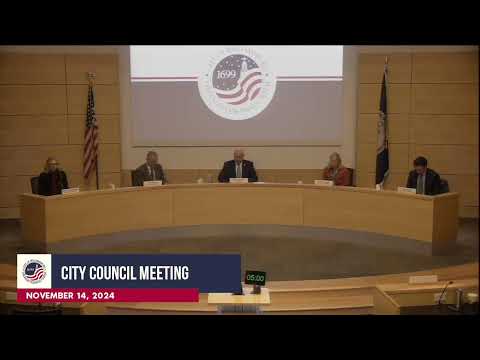
The Williamsburg City Council voted to approve PCR 24‑022 on Nov. 14, authorizing Broad Street Realty’s request to convert 8,467 square feet of vacant first‑floor retail in Building 1 of Midtown Row (221 Monticello Avenue) into five apartments. The motion passed by roll call, 5–1, with Vice Mayor Dent dissenting.
City planner Ms. Griffin told the council the project consists of two four‑bedroom units and three three‑bedroom units (17 bedrooms total) on the building’s first floor. She said the conversion would increase Building 1’s residential gross floor area to about 63.5% of the building — below the 80% threshold set for mixed‑use buildings in Midtown Row — and therefore meets zoning criteria requiring a special‑use permit. Staff analysis, supported by the city engineer, showed lower trip generation and lower water and sewer flows with the apartments than with full retail occupancy: the presentation cited 549 daily trips assuming full retail versus 251 daily trips with the proposed apartments, and small reductions in average and peak water flow.
The Architectural Review Board reviewed proposed glazing and privacy treatments for the first‑floor windows. Griffin said the ARB declined the developer’s request to use the same opaque film used on the residential upper floors and instead recommended using the same film as on other commercial windows; the ARB expects storefronts to retain a commercial look. Council members and residents raised concerns about visibility from the pedestrian corridor, enforceability of lease provisions (for example, prohibiting residents from hanging items visible from Monticello Avenue), and whether parking adjustments would be sufficient given some parking has been reallocated to serve retail uses elsewhere in the development.
Sean Mays, asset manager for Broad Street Realty, told the council the landlord had actively marketed the space for five years, offered liberal build‑out allowances, free rent and other incentives, and has a wait list of roughly 360 residential applicants for Midtown Row. Mays said leasing interest for that 8,000‑square‑foot retail bay was limited in part because its setback from the roadway and adjacent grade changes make it less attractive to many retail tenants.
Several nearby property owners and residents opposed the conversion during public comment. Sabrina Fairbanks said the city and developer previously agreed that the entire ground floor would remain commercial and warned that permitting conversions could erode the city’s retail base. Another commenter questioned whether William & Mary had been approached as a prospective tenant and urged the council to consider neighborhood balance and long‑term commercial health.
Council debate focused on two competing priorities: preserving first‑floor commercial space to support the city’s tax base and street activation, and addressing housing demand and neighborhood pressure caused by student housing outside purpose‑built developments. Supporters of the permit said the limited scope — five units in a building already largely residential with centralized amenity space — and staff data on lower traffic, parking and utility impacts weighed in favor of approval. Opponents warned of precedent and urged stronger conditions.
The council’s adopted motion approved PCR 24‑022 with a condition prohibiting occupants of the five first‑floor apartments from placing items on the interior or exterior window surfaces facing Monticello Avenue. Council also recommended that the applicant work with the Williamsburg Public Art Council and the Architectural Review Board to develop an ARB‑approved privacy/graphic treatment for the storefront glazing. The motion was approved by roll call vote, 5–1; Vice Mayor Dent voted no.
Next steps: the approval takes effect under local permitting processes and the applicant will be required to include the window/occupant restrictions in lease documents and to coordinate a privacy solution with ARB and the Public Art Council as recommended.