Get Full Government Meeting Transcripts, Videos, & Alerts Forever!
Get email alerts on the Rezoning topic
No spam. Unsubscribe anytime.
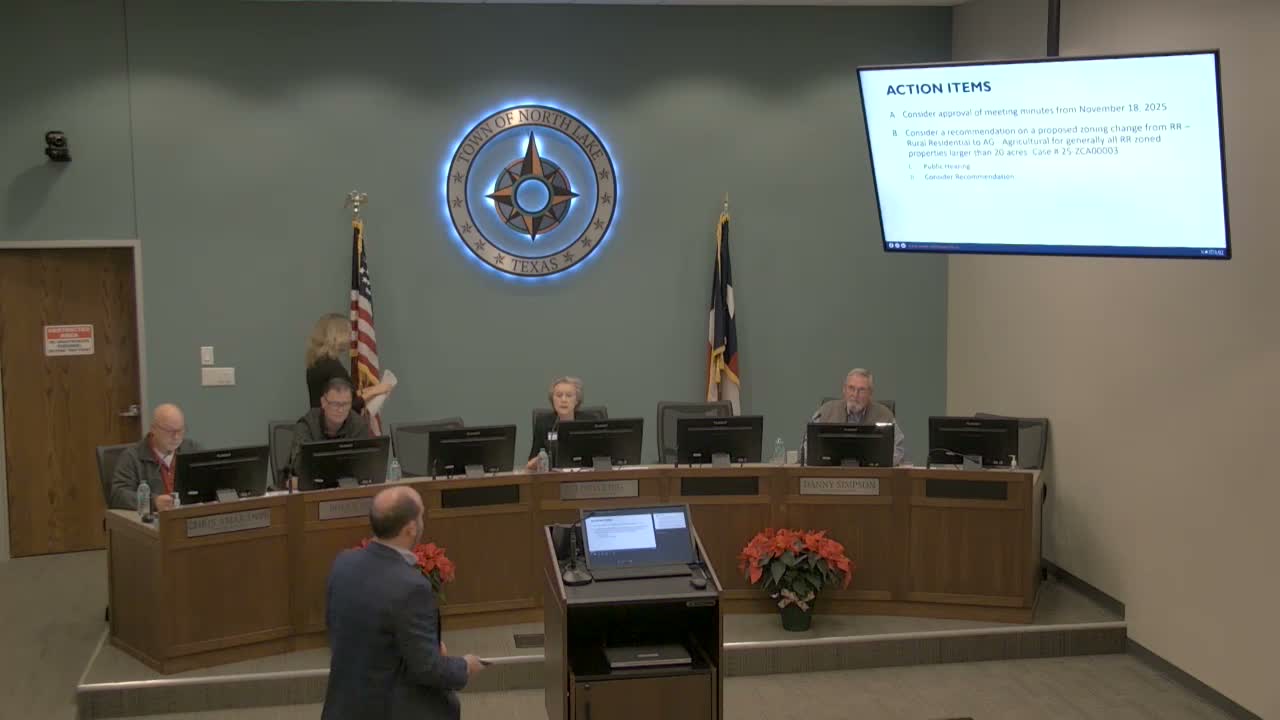
Northlake commission recommends rezoning large rural parcels to agricultural after contested public hearing
Summary
The Planning and Zoning Commission recommended approval of a town-initiated rezoning (Case 25-ZCA3) to change undeveloped rural-residential parcels larger than 20 acres to agricultural; residents raised property-rights and 'takings' concerns while staff said AG preserves larger lots and still allows single-family homes.
The Northlake Planning and Zoning Commission on Tuesday recommended approval of a town-initiated rezoning that would change most undeveloped rural-residential parcels larger than 20 acres to an agricultural zoning district (Case 25‑ZCA3).
Town planner Nathan told commissioners the agricultural designation, adopted as a district in October 2022, is intended as a holding zone consistent with the comprehensive plan and would become the base zoning for the town’s rural-reserve place type. Nathan said single-family homes remain allowed in AG, that setbacks reflect larger lot sizes, and that a 20‑acre lot could have roughly 15% building coverage (about 130,000 square feet).
The change prompted multiple residents to object during a continued public hearing. Kevin Brannon said he would oppose the proposal and warned it shifts people "from a position of certainty to a position of uncertainty" about future uses. Michael Savoie told the commission the town was "forcing a zoning change on us," arguing the action would undermine long-standing expectations for property use. Rena Hardeman, who read from materials she said were taken from the town website and minutes, said larger setbacks and additional permit and design requirements in AG amounted to a regulatory "taking" of property and urged denial.
Nathan and commissioners repeatedly said rezoning for higher density or different uses would still require a subsequent rezoning initiated by an owner or developer, not by the base zoning itself. Nathan also noted written responses changed after a second notice and explained that opposition representing 20% or more of the affected land area triggers a council supermajority requirement; staff reported about 23% of the affected area had registered opposition, so council will need a supermajority to adopt any change.
After questions and discussion, an unidentified commissioner moved and another seconded a recommendation to approve the rezoning. The chair stated, verbatim from the transcript, "Motion carries with a vote of 3 4 1 against." That phrasing and tally are ambiguous in the record; council will still need a supermajority to adopt the zoning change because of the land‑area opposition threshold.
Next steps: the commission’s recommendation will be sent to the Town Council, which Nathan said is scheduled to hold its own public hearing on the matter on Thursday night and would vote on adoption. The council must meet the reported supermajority threshold to enact the change.