Get Full Government Meeting Transcripts, Videos, & Alerts Forever!
Get email alerts on the Zoning topic
No spam. Unsubscribe anytime.
Northlake council directs staff to mirror rural-residential setbacks in new agricultural zoning and lower SUP fee
Summary
Council instructed staff to copy existing rural-residential setback standards into the Agricultural zoning district and to lower the special/specific-use permit fee from $500 to $100, directing a UDC amendment to P&Z and return for council action on Feb. 12.
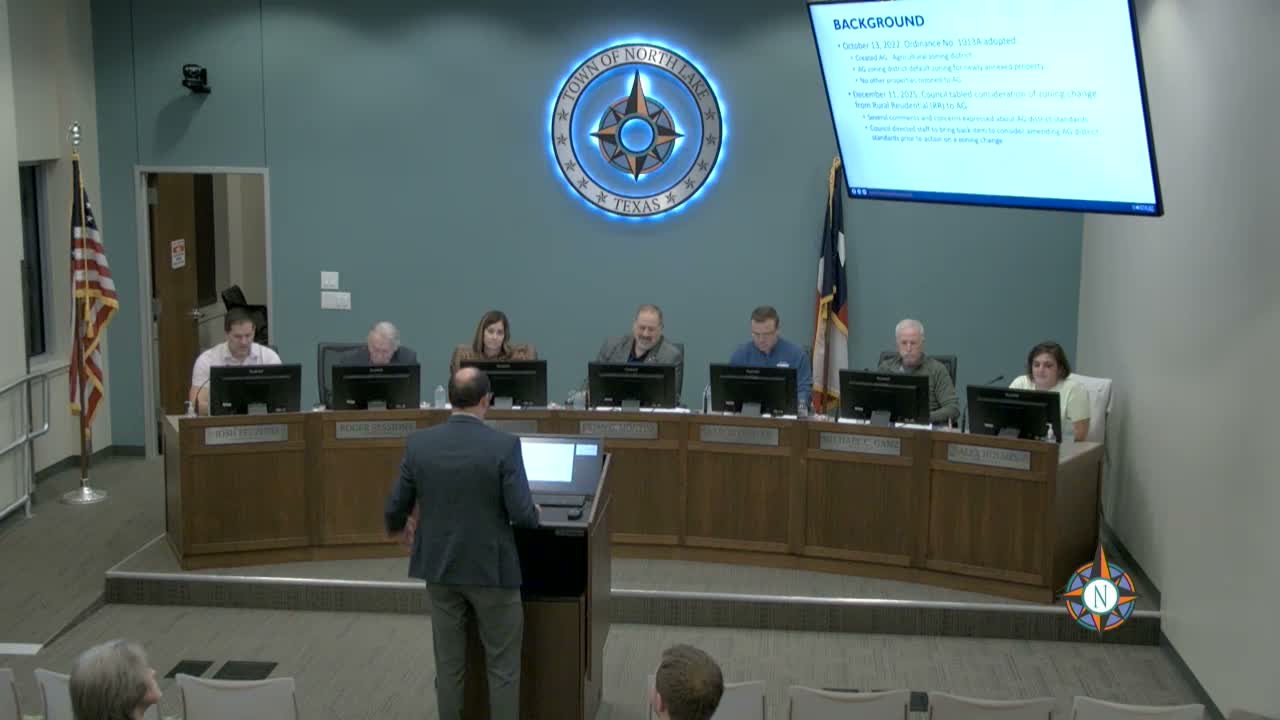
NorthlakeTown Council on Jan. 8 gave staff clear direction to adopt rural-residential setback standards for the town’s newly created Agricultural zoning district and to reduce the special-use-permit fee for agricultural parcels to $100.
Planning staff summarized the purpose of the Agricultural district and its differences from the existing Rural Residential district, telling the council the Ag district is intended for larger, primarily agricultural lots — a 20-acre minimum versus 5 acres in Rural Residential — while still allowing homes. Staff noted some standards (setbacks, dwelling area, and permitted uses) differ and that the town will draft a unified development code (UDC) amendment for Planning & Zoning and return to council on Feb. 12 for formal action.
The question of whether to keep existing Rural Residential setback requirements or change them produced a range of council comments. Several councilmembers recommended leaving the setbacks unchanged so the Agricultural district preserves the town’s rural character; others raised concerns about retroactive impacts to property owners and suggested options such as fees waivers, a grace period, or grandfathering. The council ultimately directed staff to "copy-paste" the rural-residential setback dimensions into the Ag district and to set the specific-use-permit fee at $100 for Ag parcels, a change staff will include in the draft UDC amendment.
During public comment residents expressed concern about the effect of mandatory rezoning on existing owners. Michael Savo, a longtime resident, urged the council not to treat the change as "forced zoning," saying property owners should have options or grandfathering for existing uses. Staff and council repeatedly noted that existing agricultural structures would not be removed by a zoning change and that staff will draft clear standards and a schedule for P&Z consideration.
Next steps: staff will prepare a UDC amendment based on tonight’s direction, present it to the Planning & Zoning Commission at the end of the month for recommendation and return the proposed amendment and related potential zoning changes to council at its Feb. 12 meeting.