Get Full Government Meeting Transcripts, Videos, & Alerts Forever!
Get email alerts on the Gift Card Program topic
No spam. Unsubscribe anytime.
Northlake approves $150,000 pilot gift‑card program to help businesses on State Highway 114
Summary
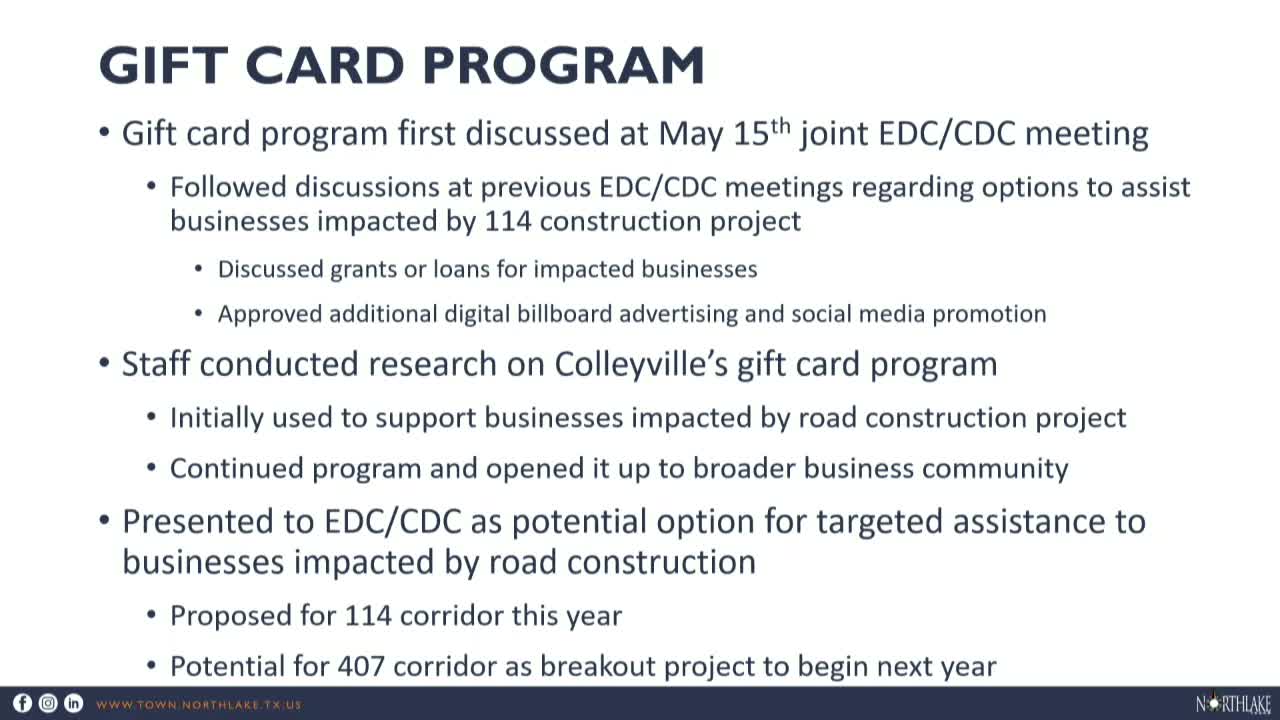
The NorthlakeTown Council ratified an EDC/CDC‑backed pilot to mail $25 vouchers to town households for use at selected businesses on State Highway 114, approving two readings and a $150,000 budget amendment; the program bars gasoline, tobacco/vapes and alcohol purchases and will be evaluated using visit and sales‑tax data.
The NorthlakeTown Council on an evening vote approved a pilot gift‑card program aimed at businesses affected by construction on State Highway 114, ratifying EDC and CDC recommendations and adopting a $150,000 budget amendment to fund the effort.
Staff described how the program will work: $25 vouchers or mailed postcards would go to every Northlake household and would be redeemable only at participating SH‑114 businesses that generate sales tax and have primary frontage on that corridor. Participating businesses would collect the vouchers and be reimbursed $25 each; staff estimated $7,000 for printing and postage and said the $150,000 allocation — split $75,000 to each development corporation — was intended to cover a broad usage scenario. "So this would be $25 value gift cards just distributed to, every Northlake household," staff said during the presentation. Staff also stated the distribution method had safeguards to limit redemptions to Northlake residents and said the program was designed to be resistant to fraud.
Why this matters: council members said the program is a way for the town to support local restaurants and retailers that, staff said, have seen declines in visits and sales tax tied to road construction. Staff cited Placer AI visit metrics and local sales‑tax trends as the main evidence for targeting SH‑114; a councilor noted Placer AI visit data typically updates quickly while sales‑tax data lags by months.
Council debate focused on scope, measurement and perception. Supporters argued a narrowly targeted pilot preserves the signal of effectiveness and allows the town to measure outcomes; opponents said sales‑tax‑funded EDC/CDC money should not be used as what one resident called "a ridiculous waste of money." A councilor raised a separate concern that if an individual business owner had campaigned privately for the program to boost that business’s value it would be inappropriate; staff and boards said they were unaware of any such direct solicitation.
The council placed limitations on the program. The town attorney and staff confirmed the vouchers may not be used for gasoline, cigarettes or vaping products, or alcohol. Staff also confirmed there will be no cash back. The program requires a Type B project process (public hearing and a 60‑day waiting period); staff said notice had been published and that the 60th day would fall on Aug. 27, with mailing to begin as soon as practicable after that date if the council’s approvals stand.
Votes and next steps: the council carried the first reading of the resolution 4–2, carried the second reading 4–2, and adopted a budget amendment to allocate $75,000 to each board (total $150,000) by a 4–3 vote. Staff will track voucher redemptions, Placer AI visit metrics and subsequent sales‑tax reports and return with a measurement report so council members can assess whether to expand the program or run a similar pilot for the SH‑407 corridor at a later date.
Direct quotes in the meeting included staff’s description of the voucher distribution, a staff assurance that "Lauren assured us it was fraud proof," and public comment that the program would be a poor use of tax dollars: "This is a ridiculous waste of money."