
Auditors report no material weaknesses; GASB change balloons reported accumulated‑absence liability
Get AI-powered insights, summaries, and transcripts
Subscribe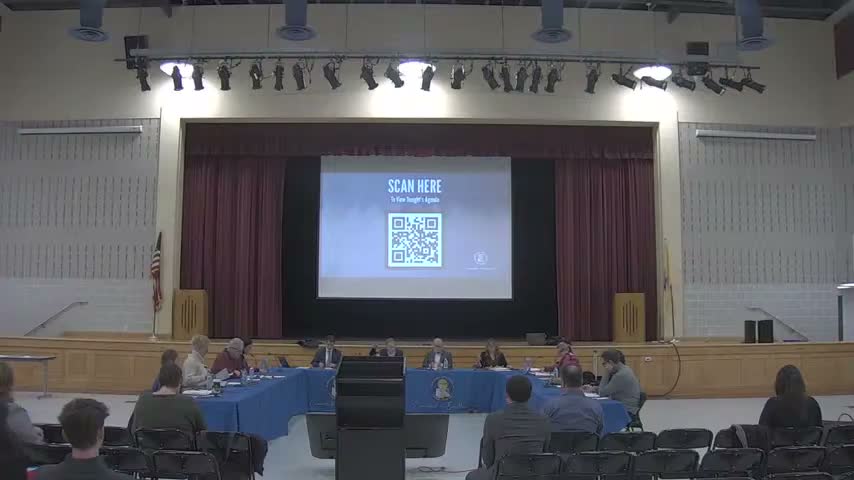
Summary
Independent auditors told the Marlboro Township Board the district’s FY24–25 audit found no internal control issues or material weaknesses but included an "emphasis of matter" tied to a new GASB standard that increases the reported accumulated‑absence liability on the financial statements from the previously noted ~$2.5M footnote to about $20M on the face of the statements; auditors said this is a reporting change, not a cash obligation.
The Marlboro Township Board of Education heard the district’s FY24–25 independent audit on Tuesday, when external auditor Robert Mulligan told the board the review found "no internal control issues, no significant deficiencies, material weaknesses to report." Mulligan presented the audit and fielded questions from board members.
The audit includes an "emphasis of matter" relating to a new Governmental Accounting Standards Board (GASB) requirement that changes how accumulated employee absences are shown on the face of the financial statements. Mulligan said the change increases the reported liability because the district must now display the full amount earned rather than the capped payout historically shown in a footnote. "So for instance, for you guys, in the past, this would have been in your notes as about 2 and a half million dollars," Mulligan said. "For this year in your financial statements, you'll see that number is about $20,000,000. That's just simply due to the number of employees that you have, the amount of time that they have accrued." He added, "Again, you are not gonna have to pay $20,000,000 to anybody. Your actual liability is probably around 2 and a half million dollars."
Mulligan also reviewed the district’s fund balances and reserves. The district ended the year with roughly $13 million in fund balance, with capital and maintenance reserves of about $3.5 million and $2.0 million respectively. He told the board the food‑service fund was “very healthy,” noting roughly $1.0 million in that fund, of which about $640,000 represents capital assets such as refrigerators and stoves (the auditor clarified that figure is a net asset value, not cash available for operations).
Board members asked whether auditors flag best practices when they appear during testing. Mulligan said auditors do not provide an opinion on internal controls but will note significant deficiencies or material weaknesses when warranted and may report lesser recommendations as best‑practice suggestions. "There's also, you know, minor things that you'll see at basically every district that, you know, we can report back on, at a lesser level," he said.
The auditor provided copies of the report to board members and said staff in the business office supplied the numbers. The presentation concluded with the board thanking Mulligan and the finance staff for their work.
What’s next: The board received the audit and had the opportunity to request further detail; Mulligan indicated staff could provide breakdowns of line items on request.