Get Full Government Meeting Transcripts, Videos, & Alerts Forever!
Get email alerts on the Federal Earmarks topic
No spam. Unsubscribe anytime.
Montgomery County Council agrees to submit 11 federal earmark requests including bus lanes, public-safety center and AI policing pilot
Summary
The council approved submitting 11 proposed federal earmark requests to its congressional delegation, including transportation projects, public-safety and youth programs, public-health services and a police–University of Maryland AI policing collaboration. Staff warned federal eligibility is uncertain and portals require timely submission.
Montgomery County’s council voted to submit a slate of 11 proposed congressional earmark requests to its federal delegation, covering transportation upgrades, public-safety projects, youth programs and health services.
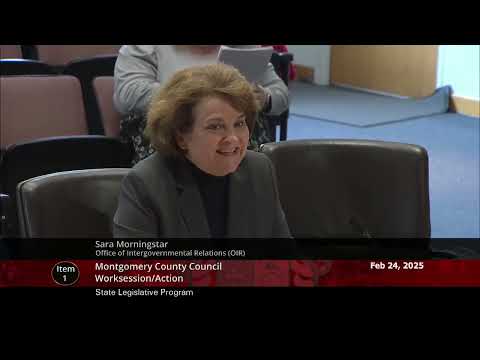
Sarah Morningstar of the Office of Intergovernmental Relations briefed the council on the list and the March 7 portal deadlines for some members’ offices. The proposals include a Wheaton environmental arts 'streetery' project ($1.8 million); an out-of-school-time network to provide developmental education and mentoring ($1.0 million); a joint public-safety operations center ($3.2 million); a perimeter fence and gate for a public-safety technical operations office ($975,000); a youth public-safety immersive summer program ($200,000); mobile crisis outreach vehicles ($200,000); an HIV/sexually transmitted infection public-health service request ($776,138); DOT requests for Georgia Avenue temporary bus lanes ($6.4 million), a right-of-way stump-removal request (eligibility unclear), and high-efficiency street-lighting in priority county sections ($1.24 million); and a police–University of Maryland collaboration to pilot AI-enabled predictive policing and community engagement (about $4.0 million).
Morningstar cautioned that the federal picture remains “murky” and that some requests may not map cleanly to eligible federal accounts; she summarized the approach as “almost sort of a no ask, no get,” urging submission so the delegation can consider county priorities. After the briefing a council member moved to submit the list and the council raised hands in favor; staff will enter the projects in congressional portals for consideration.
Why it matters: earmarks can unlock federal funds for local capital and program needs but must meet account-specific eligibility. County staff flagged projects that they believe may fit FEMA, HHS or DOT accounts, and noted several requests depend on congressional receptivity and timing.
What’s next: staff will submit the projects to delegation portals and monitor openings for other members; the council directed staff to proceed with filing the requests by the noted deadlines.