
Covington explores public‑safety sales tax, grant options to fund additional officer
Get AI-powered insights, summaries, and transcripts
Sign Up Free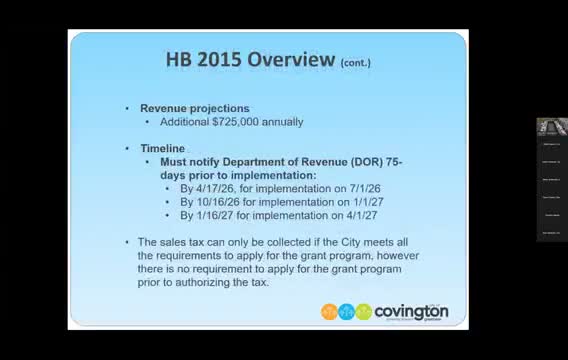
Summary
Council directed staff to develop voter materials and options to use a 0.1% public‑safety sales tax and grant funding to support hiring a new officer amid rising public‑safety costs; staff reported revenue estimates and a limited, short‑term grant available through 6/30/2028.
Covington — Council members on Saturday asked staff to return with refined options for a public‑safety dedicated local sales tax after a staff presentation on funding pressures for policing.
Staff explained House Bill 2015 would allow a 0.1% (one‑tenth of 1%) local sales tax dedicated to criminal justice purposes that the city could keep entirely rather than share with the county. Staff said revenue projections varied with the city’s tax base but that initial estimates were in the range of several hundred thousand dollars annually; staff also noted the state offered a one‑time grant program that could contribute up to $125,000 toward a newly created officer’s first‑year cost, through June 30, 2028, but cautioned that the grant was limited and not a reliable long‑term funding source.
Council members cited falling crime statistics for many serious categories and stressed the public’s expectation that the city explain why it sought new revenue. “We need to be constantly communicating why this is necessary,” one councilmember said, urging staff to prepare clear public messaging that ties rising county costs and new state requirements to the request.
Police staff and council also discussed alternatives to adding sworn officers, including expanding the community care specialist program, which several councilmembers praised as a lower‑cost public‑safety intervention. Council gave staff consensus direction to prepare ballot‑ready options, voter‑education materials, and a timeline for deciding whether to place a sales‑tax proposal on a future ballot.
Next steps: staff will return with detailed revenue projections, draft messaging for businesses and residents, and options for combining sales tax revenue with any available grants to hire and sustain additional public‑safety personnel.