
Covington council moves to refine park‑district options after survey shows support for parks and rec upgrades
Get AI-powered insights, summaries, and transcripts
Sign Up Free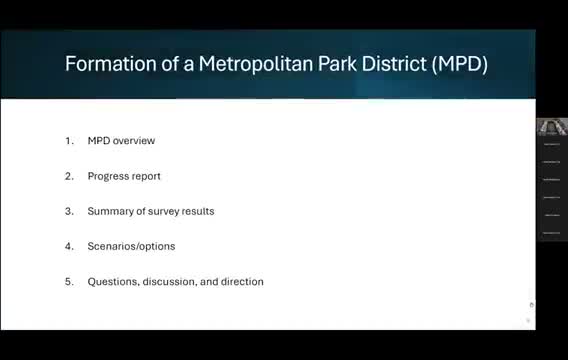
Summary
After a city survey showed top interest in a new aquatics center and park upgrades, Covington council directed staff to refine Metropolitan Park District scenarios for an August 2026 ballot, aiming to balance upfront capital and operating needs while testing voter appetite for a modest initial levy.
Covington — City leaders told staff to refine options this week for forming a Metropolitan Park District (MPD) after a year of outreach and a resident survey showing strong interest in park and recreation investments.
The MPD discussion centered on survey responses from 393 people (253 identifying as Covington residents), who ranked a new aquatics and recreation center, upgrades at Covington Community Park, Jenkins Creek trail and park improvements, and expanded park maintenance as the top priorities. Staff presented three illustrative levy scenarios: about $0.23, $0.37 and a statutory ceiling of $0.75 per $1,000 of assessed value, each producing different combinations of capital and operating capacity.
Ethan with city staff said the MPD could provide steady annual revenue dedicated to parks and recreation, and — depending on the levy — allow the district to accumulate reserves or take on non‑voted debt so projects could be delivered sooner. “An MPD gives us tools to fund maintenance and phased capital improvements without adding to the general fund competition,” he told council.
Council members debated trade‑offs between an initial lower levy that voters might accept and a higher levy that could deliver more immediate capital. Several members favored an initial planning target in the 23¢–37¢ range per $1,000 of assessed value, while keeping the statutory ceiling available for the future if voters later approve higher funding.
Council gave staff direction to continue refining levy and debt‑service scenarios, produce clearer voter‑facing materials showing what different rate levels would buy, and aim for a possible August 4, 2026 ballot if the timelines and legal steps line up. Staff will return with the requested options and language for the council to consider before placing any measure before voters.
Councilmembers stressed the need to show the public concrete, near‑term benefits and clear timelines. One councilmember said a phased approach — starting with higher‑use improvements such as lighting and turf upgrades at existing fields — would help residents see results sooner.
Next steps: staff will finalize cost estimates, refine the proposed initial levy level for outreach materials, and prepare draft ballot language and procedural steps for council review.