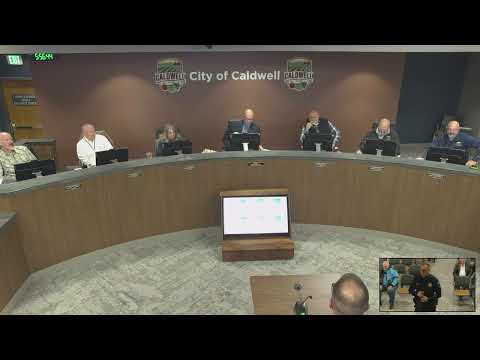
Caldwell police outline drone-first responder program, privacy safeguards and early results
Loading...
Summary
Caldwell Police Captain Rob Rosen told a council workshop the department’s Drone First Responder (DFR) program and real-time information center combine drones, automated license-plate readers and cameras to speed responses, reduce pursuits and aid investigations; officials emphasized a public transparency portal and internal audit controls.
Captain Rob Rosen of the Caldwell Police Department outlined the city’s Drone First Responder (DFR) program and real‑time information center at a council workshop, describing how drones, automated license‑plate readers (ALPR) and a video management system work together to speed responses, reduce risky pursuits and provide evidence to prosecutors.
Rosen said the department has three Skydio drone docks deployed and that the city will pay about $125,000 to field those docks over five years. He described operational safeguards — including a public transparency portal whose flight records and basic flight details can be viewed on the city’s website — and said the department has disabled continuous recording from takeoff to return to limit incidental collection. "This is the best project I've seen rolled out," Rosen said, adding staff and supervisors operate and audit access to the systems.
The presentation emphasized legal limits and policy controls. Rosen cited Idaho law (identified in the presentation as Idaho Code 21‑213) and said the department limits drone and ALPR use to accidents, critical events, disasters, training, public‑safety responses and uses authorized by warrant. He also described internal controls: only supervisors or detectives may run searches of ALPR and camera records, searches must cite a case number, and audits review search reasons.
Rosen gave an inventory of equipment and retention rules: 47 ALPR units across the city, 40 traffic livestream cameras and 27 gunshot‑detection devices. The department’s ALPR image retention policy is 30 days, Rosen said, "more strict than what the state allows." He added pilots are FAA Part 107 certified and that some Skydio drones can operate beyond visual line of sight (BVLOS) to reach remote calls more quickly.
Rosen showed operational examples the department says illustrate the program’s public‑safety benefits: an infrared drone search of a three‑year‑old missing child that located the child inside a house, and a pair of burglary incidents at "Idaho State Towing" where drones helped locate two suspects in vegetation and relay positions to officers. Rosen said those cases allowed officers to locate stolen property and make arrests while limiting risk to personnel; in one example he said suspects included "11 years old." Rosen also presented a live demonstration of an ALPR hit, where RTIC pilots launched a drone to follow a stolen vehicle and coordinate a staged stop with field units. Rosen said the system reduces the need for high‑risk vehicle pursuits by providing time and situational awareness.
Early operational metrics presented to the council included an average of 3.3 flights per day, drones arriving first on scene 51% of the time and drone‑only responses in 12.9% of flights. Rosen said Part 1 crime declined by 12% year over year (119 fewer Part 1 crimes from 2024 to 2025), while cautioning that multiple factors — not any single tool — likely contributed to the change.
Council members asked about visible identification lights on drones, cooperation with neighboring jurisdictions, ALPR hits from national databases and drone range. Rosen said the drones carry red and blue lights that can be turned off when needed, the department currently operates only three docks limiting coverage of outlying areas, NCIC hits (stolen vehicles, warrants, missing persons) will trigger alerts through Flock, and Amber‑Alert plates are manually entered on a hot list to trigger faster matches. He provided an RTIC contact email for public questions (rtic@cityofCaldwell.org) and pointed attendees to the transparency portal and QR code shown during the presentation.
No formal council motion or vote was recorded at the workshop. The mayor closed the presentation and called a five‑minute recess before the regular meeting.
Sources: presentation and live demo at the Caldwell City Council workshop; statements attributed to Captain Rob Rosen and RTIC staff during the presentation.