Get Full Government Meeting Transcripts, Videos, & Alerts Forever!
Get email alerts on the Affordable Housing topic
No spam. Unsubscribe anytime.
Tempe unveils draft affordable-housing "bonus" program offering density and height in exchange for long-term affordable units
Summary
City planning staff presented a draft citywide development bonus program that would let developers receive additional density, height and reduced parking in return for dedicating a percentage of new units at 50%, 65% or 80% of area median income (AMI) for 30 years; residents warned the streamlined, administrative path could reduce public input and may displace existing affordable stock in some neighborhoods.
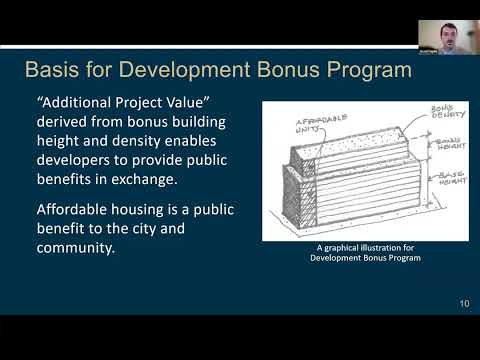
City of Tempe planning staff on an online public presentation laid out a draft development bonus program that would let private developers opt in to receive additional height, density and parking relief in exchange for providing on-site affordable housing under multi-tiered AMI targets.
Ryan LeVaque, Deputy Director for Community Development and Planning, said the proposal is a draft intended to solicit public feedback before staff prepares an ordinance for formal hearings. "This is a draft proposal, so we're looking to get public feedback on this before, we officially move forward with any final or proposed refinement," LeVaque said. Staff said the proposal is voluntary: developers choosing the bonus would sign a covenant guaranteeing the affordable units for a 30-year term.
The program ties bonus capacity to the city's updated general-plan land-use projections and would operate citywide as an administrative option for sites that already align with the general plan. Jacob Payne, principal planner for long-range planning, explained that legal constraints shape the approach: "In Arizona, the state statute prohibits what's called inclusionary zoning," Payne said, but the same statute permits incentive-based bonus programs. Under the draft, bonus units would be set aside at one of three affordability tiers (50%, 65% or 80% AMI) and could require 25% to 75% of the added units be dedicated depending on the density jump.
Staff showed sample tables and described a proposed new R6 zoning category (not yet mapped) to allow up to 45 dwelling units per acre. Payne said R6 would require a separate rezoning and public hearing to apply: the R6 designation is an option for sites that request it, not an automatic mapping change. LeVaque added that for mixed-use or commercial zones, residential uses may be allowed by use permit and that industrial areas with new mixed-use designations are potential candidates for conversions.
On enforcement and longevity, LeVaque said developments that opt in would execute a covenant "between the city and the landowner" and that covenants are transferable to successors: "It is between the city and the the landowner," he said. The covenant would require the affordability commitments for a 30-year term, with self-certification, annual reporting and potential auditing by the city's code compliance division.
Staff emphasized administrative processing as an incentive to reduce time and uncertainty for developers compared with the conventional rezoning or general-plan amendment route. "The administrative processing of it is just kind of one component of the incentive," Payne said, arguing the combination of predictable entitlements and development standards is intended to make affordable units more likely to be delivered.
Residents and participants used the Q&A to press several concerns. One resident, David, warned that reducing public hearings could "build resentment" and said he feared the bonus calculations could, in some R3 areas, replace existing affordable housing rather than increase it. "I think that any program that doesn't allow public input or have a public hearing process is gonna build resentment towards the program and affordable housing in general," David said. He added that in some R3 areas the math, as he read it, would yield fewer low-income units per acre than currently exist unless much higher densities are achieved.
Other questions addressed whether the city would let developers "buy" bonuses for cash (staff said past programs included financial options but favored on-site units to guarantee long-term affordability), how students would be treated (staff said some programs exclude students and that student eligibility will be considered), and whether parking fees might be unbundled to avoid charging residents extra. Staff said they will consider unbundled parking approaches and asked for written comments on specific ratios.
Staff gave examples from past projects to illustrate scale: Payne pointed to a mixed-use project on Apache Boulevard that reached roughly 60 dwelling units per acre with building heights near 80 feet, noting comparisons vary by setbacks and design. On geographic exclusions, staff said the ASU Novus (Athletic Facilities District) overlay would not be subject to the bonus because it already has its own density rights and a joint review committee.
Next steps and how to comment: staff said the online survey and forum are open through Jan. 20 and planned to report preliminary feedback to the City Council on Feb. 12, with a drafted ordinance and public hearings possible in April through June if direction proceeds. Staff also announced an in-person presentation at the Tempe Public Library that evening and provided contact and survey links on the city's website.
The City asked for detailed written comments on parking ratios, unit-type mixes to support families, student eligibility rules, and neighborhood-specific concerns so staff can refine the draft before formal ordinance drafting.