
EDA webinar outlines governance expectations for Path 3 coalitions
Get AI-powered insights, summaries, and transcripts
Sign Up Free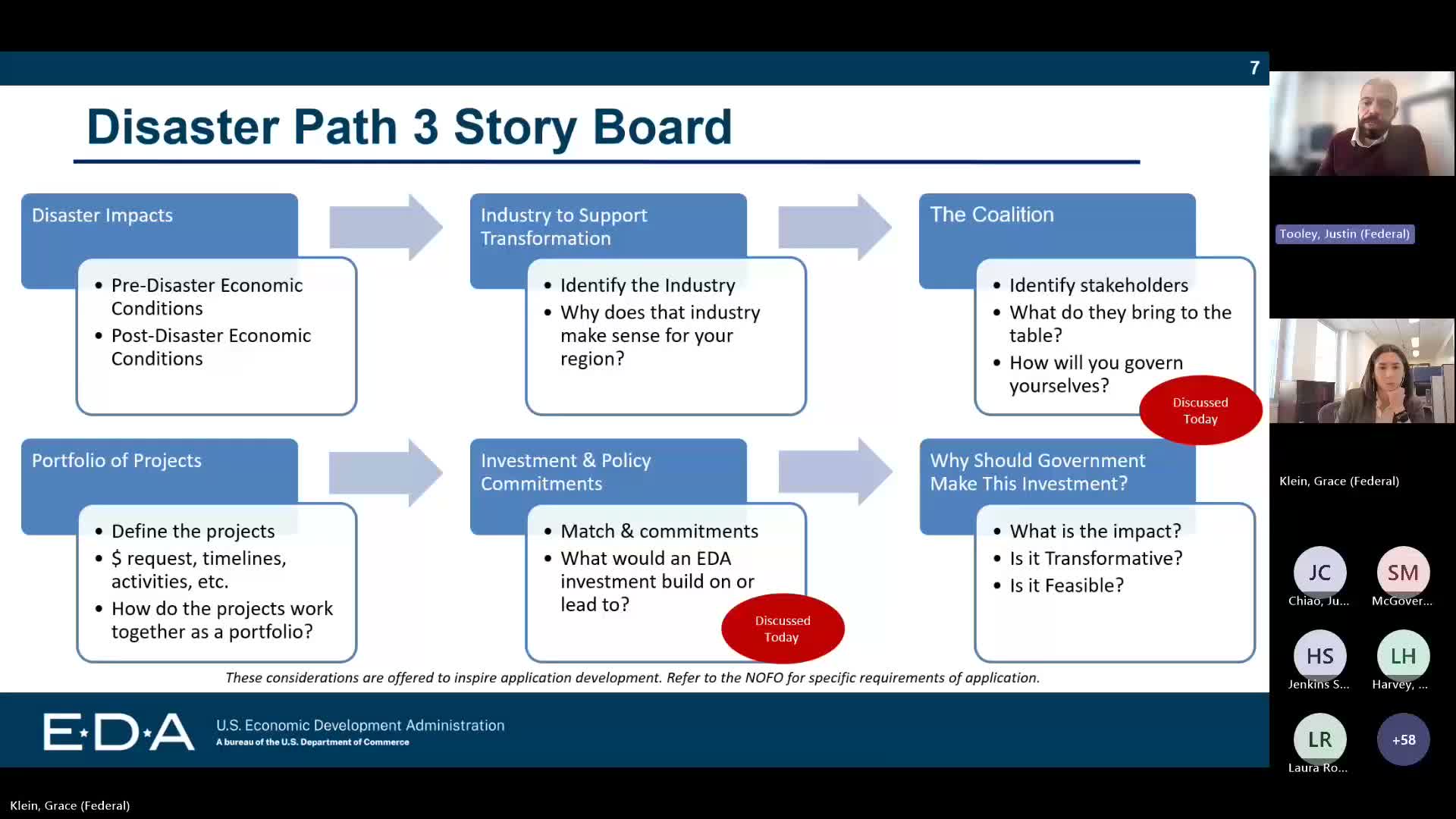
Summary
The Economic Development Administration told potential Path 3 applicants to build coalitions with a clear lead entity, defined project leads, measurable governance activities in budgets, and shared performance data to drive accountability and resiliency across up to five years of performance.
Grace Klein, presenter for the Economic Development Administration (EDA), told applicants during a Feb. 3, 2026 webinar that governance should be “the frameworks, agreements, and mechanisms used to organize individual entities and align them towards common goals.” The guidance applies to Path 3 (industry transformation) proposals under the FY2025 Disaster Supplemental NOFO.
Klein said a clear organizational structure helps EDA understand who will manage a portfolio of 3–5 component grants and how those component projects will work together to produce transformative outcomes. She described a typical coalition as centered on a lead entity — “the front door for your coalition” — surrounded by component project leads who sign award agreements with EDA, subrecipients and commitment-makers with narrower scopes, and advisors or validators who provide subject-matter expertise.
Applicants were advised to embed governance across their application: include budget lines for coalition convenings, staffing for a lead-entity manager and data analysts, web services for coordination or external communication, and resources for shared performance-data collection. Klein said those items demonstrate the coalition’s ability to coordinate across multiple projects and to translate progress into measurable outputs.
Speakers repeatedly stressed the importance of specifying roles and decision-making processes up front to avoid later disputes. Klein told attendees to design decision-making, conflict-resolution, and power-sharing structures, and to set clear approaches for accountability and learning through shared metrics. She urged coalitions to plan for leadership resiliency so success does not depend on a single individual over a multi-year performance period.
Justin (EDA presenter) reinforced that reviewers evaluate governance as part of a holistic feasibility and coalition-strength assessment, and that governance elements will affect two-thirds of the application score through disaster-recovery need, project strategy and feasibility, and coalition strength.
The presenters offered concrete examples — e.g., a workforce-training-center coalition should name core implementers (training providers), employers who will hire graduates, community colleges that accept credentials, local government for permitting, and support-service organizations to ensure trainees can access the center. The speakers advised applicants to explain how these partners will operate together rather than simply listing names.
The webinar closed with a reminder that governance does not have to be fully detailed before applying but should be reflected clearly at a high level in the overarching narrative and budgets so reviewers can see how the coalition would function if awarded.