SIU trustees hear School of Pharmacy report on NIH‑funded cancer drug discovery and cooperative PhD work
Loading...
Summary
At a Board of Trustees meeting, the School of Pharmacy presented NIH‑funded drug‑discovery work, including a novel molecule the presenters called EEG‑29; trustees praised the program and asked about grant stability. The board did not take action on research funding at this meeting.
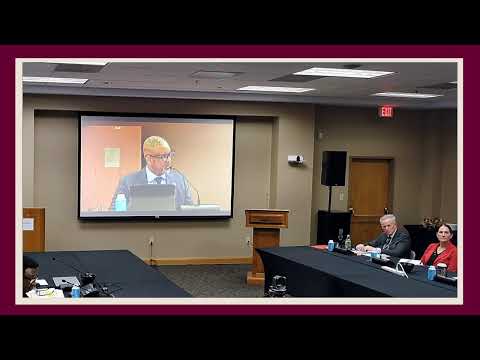
The Southern Illinois University Board of Trustees heard a presentation Feb. 6 from the School of Pharmacy detailing research on new approaches to slow cancer growth, including a novel compound the presenters identified as EEG‑29.
Provost Scott introduced Dean Mark Luehrer, who summarized the school’s development since its first PharmD graduates in 2009, its accreditation and training outcomes. Luehrer said the program has produced nearly 1,300 graduates and that 85% of students come from Illinois, with 75% from central and southern parts of the state. He told trustees the school’s overall graduation rate is about 96% and that its first‑time licensure pass rate ranks first in Illinois.
Dr. Bhargav Patel, an assistant professor of pharmaceutical sciences, described two research strategies his laboratory is pursuing: blocking the cell’s uptake of amino‑acid building blocks (referred to in the presentation as LAT1/LAT‑type transport) and disrupting the mRNA‑translation machinery known as the EIF4F complex. Patel said his lab has discovered a novel molecule, EEG‑29, and that the work is supported by a four‑year NIH grant currently in its third year; he said the team has submitted additional proposals to NIH and the American Cancer Society and filed disclosures with the university tech‑transfer office.
"This is a collaborative project between my lab and my colleague," Patel said, describing aims to ‘‘stop the protein production machinery’’ that cancer cells rely on.
A first‑year co‑op PhD student, Amrita, explained the EIF4F complex in lay terms and described laboratory results showing EEG‑29 can disrupt interactions among EIF4F components (4E and 4G). She said EEG‑29 compares favorably in laboratory measures with an older compound previously reported in the literature and emphasized the cooperative PhD program with the SIU School of Medicine as a driver of the work.
Trustee Justin Hightower publicly praised the school’s leadership and research accomplishments and noted earlier federal‑level uncertainty over research grants, saying that stability of federal funding had been a concern in recent years. "I just wanna underscore for the board that this is one of the grants that we were concerned about and could be subject to being revoked," he said, while expressing encouragement for the local discovery happening at SIUE.
Presenters did not request board action at this meeting. They described next steps as pursuing larger grants and further tech‑transfer disclosures. The trustees’ remarks were largely supportive; no formal vote or funding decision on the research was recorded in the provided portion of the transcript.