Get Full Government Meeting Transcripts, Videos, & Alerts Forever!
Get email alerts on the Legislative Tracking topic
No spam. Unsubscribe anytime.
Building Code Council legislative committee reviews bill tracking; members flag embodied carbon bill concerns
Summary
The State Building Code Council legislative committee reviewed its bill-tracking sheet Feb. 5, moved HB2486 into a high-priority column for monitoring, and members raised technical and rulemaking concerns about an embodied carbon bill that could constrain future code rulemaking.
The State Building Code Council legislative committee met Feb. 5 to review its bill-tracking sheet and the legislature's calendar, and to discuss several bills that could affect the council’s future rulemaking.
Committee Chair called the meeting to order, confirmed a quorum and the committee approved the posted agenda and minutes by voice vote. The committee then ran through its tracking sheet and upcoming legislative cutoffs, with presenters noting the policy cutoff had passed Feb. 4 and the house-of-origin cutoff is Feb. 17.
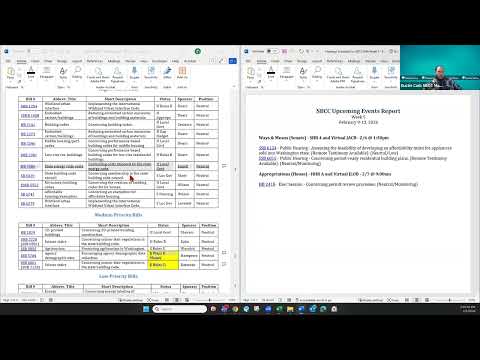
Why it matters: The council monitors bills that could change statutory direction to code administrators or require the council to adopt new rules. Members moved HB 2486 from monitoring into a high-priority column to watch for hearings or changes. Presenters also highlighted SB 6015 on permit-ready residential building plans, which as amended would require plans to be designated compliant with a specific code version and remain valid only while that code is in effect.
Members voiced substantive concern about an embodied carbon bill that, if enacted, would require the council to make technical determinations in statute rather than through the council’s rulemaking process. Committee member Micah said the bill “ties your hands to legislative language on things that could be addressed through the rulemaking process,” and pressed that the legislation would require the council to set calculations (for example, how “90% of covered products” is determined and industry-average baselines) that are typically handled in technical rulemaking. Another member noted the bill carries a significant fiscal note and currently sits in capital/appropriations committees, which may determine its near-term prospects.
Outreach and next steps: A committee member reported contacting Representative Durr with suggested language closer to HB 2381 that would provide general direction rather than prescriptive technical mandates. Members agreed the legislative committee would not take an official position on bills without a full council vote but said they would monitor developments closely; one member said a special legislative committee meeting could be convened if the embodied carbon bill comes up for hearing.
Other tracking notes: Presenters reviewed medium- and low-priority bills including SB 5784 (agency demographic data collection), SB 6001, SSB 6026 (residential development in commercial/mixed-use zones) and SSB 6124 (appliance affordability index). The committee noted two bills previously shown for hearing that day were no longer scheduled.
The meeting closed after brief additional remarks about national standards activity; no formal policy positions were adopted. The committee will continue to monitor the bills listed on its tracking sheet and reassess after the Feb. 17 house-of-origin cutoff.