
Wayne County commission urges state, federal action to remove toxic chemicals from hair and beauty products
Get AI-powered insights, summaries, and transcripts
Subscribe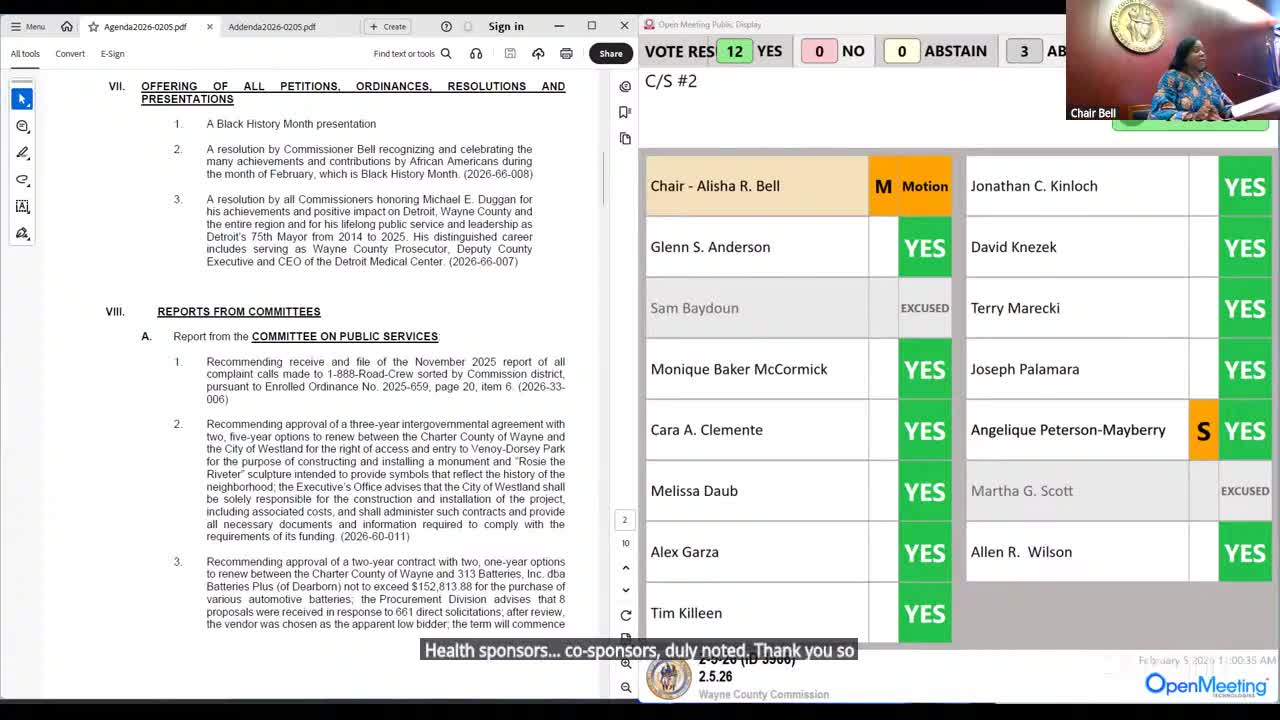
Summary
Commissioner Baker McCormick introduced and the commission approved a resolution urging the Michigan Legislature and U.S. Congress to require ingredient disclosure, clear labeling and bans on known carcinogens in hair and beauty products that disproportionately affect Black women.
The Wayne County Commission on the floor voted to endorse a resolution calling for state and federal action to remove known carcinogens and toxic chemicals from hair and beauty products, including synthetic braiding hair, commissioners said.
Commissioner Baker McCormick introduced the measure, saying independent testing and public-health research have identified formaldehyde-releasing agents, benzene contaminants, phthalates and other compounds in products marketed to Black women that can cause baldness, skin irritation, respiratory concerns and long-term health risks. "Black women should not have to choose between their health and their identity," McCormick said, urging the county's legislative delegations to act.
The resolution, moved by McCormick and supported by Commissioner Wilson, asks the Michigan Legislature and the U.S. Congress to require full ingredient disclosure, clear labeling and enforceable safety standards for beauty and hair products. The commission carried the motion by voice vote; no roll-call tally was recorded.
Supporters said products such as synthetic braiding hair can remain in contact with the scalp for weeks and are largely unregulated, and they framed the measure as a public-health and equity action rather than a partisan issue. "We deserve protection," McCormick said.
The resolution does not itself change county law or impose fines; instead it directs the commission to seek changes by state and federal lawmakers and invites cosponsors from fellow commissioners. The text presented at the meeting listed named categories of compounds and asked for labeling and disclosure requirements; specific implementation steps and enforcement mechanisms were not specified at the floor meeting.
The commission approved the measure and opened the board for cosponsors following the vote. The item will be transmitted to the relevant state and federal legislative contacts named in the resolution.