SoCalGas outlines programs that cut roughly 6.4 billion cubic feet of methane; pauses in 2025–27 tied to CPUC resolution
Loading...
Summary
SoCalGas told a CPUC workshop that four programs — blowdown reduction, leak‑inventory acceleration, increased leak surveys and aerial monitoring — together reduced roughly 6.4 billion cubic feet of natural‑gas emissions since 2018. The company said CPUC Resolution G3605 pauses key activities for 2025–27 and it will seek reinstatement in the 2028 GRC.
SoCalGas representatives laid out four core strategies that the company says reduced roughly 6,400,000,000 cubic feet of natural‑gas emissions between 2018 and 2024. Company program and project manager Josh Stanford identified those strategies as transmission blowdown reduction, leak‑inventory reduction, accelerated leak surveys and aerial monitoring.
Stanford said the blowdown reduction toolbox — including gas capture, cross compression and drafting — alone accounted for 1,400,000,000 cubic feet of avoided emissions since 2018, and that “during 2024 calendar year, we reduced the volume of transmission pipeline blowdowns by 95%.” He described the work as cost‑effective and noted the program is authorized under the CPCU process referenced as Resolution G3605 for years 2025–27.
The presentation said the leak‑inventory reduction effort began accelerating in 2020, moving repair priorities to older leaks first and improving the inventory metric from 32 months to single‑digit average repair times by 2023–24. Stanford told the workshop that SoCalGas achieved about an eight‑month average repair time for nonhazardous maintenance service‑line leaks in 2023–24 and attributed about 1,800,000,000 cubic feet of reductions to these efforts.
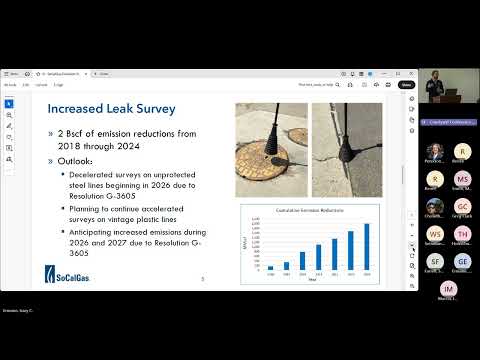
Stanford described accelerated surveys on vintage plastic and unprotected steel and said those survey changes contributed roughly 2,000,000,000 cubic feet of reductions from 2018–2024. He also described an aerial monitoring helicopter program that began partial operation in 2021 and which the company reports abated about 1,200,000,000 cubic feet through 2024 by detecting leaks on company and customer infrastructure.
Multiple CPUC staff and workshop participants pressed SoCalGas on near‑term projections. Stanford said Resolution G3605 did not authorize continuation of certain programs at prior levels for 2025–27, creating a projected short‑term increase in emissions linked to slower survey cycles and longer average leak durations. He added that the company plans to propose reinstatement of key programs in its 2028 General Rate Case (GRC) filings.
SoCalGas also proposed technical refinements for reporting accuracy: shifting mileage‑based estimates to leak‑based emission factors, developing company‑specific venting factors for Appendix 2 and 3 sources, and adapting the Appendix 4 unknown‑leak framework to avoid double‑counting when aerial or mobile surveys are in use. Stanford cited a pilot with USPS vehicles collecting passive mobile methane data as an example of operational innovation that could inform future accounting and detection.
Next steps the company identified are to include program elements in forthcoming compliance plans where authorized, to collect additional measurement data for company‑specific factors, and to pursue reinstatement of paused programs in the 2028 GRC process.
The workshop record shows commissioners and Energy Division staff seeking more detail on projected emission increases from the pause in programs and asking SoCalGas to provide timing and repair‑duration metrics that would support a 2028 GRC proposal.