
Catalina Foothills board opposes current Pima JTED bond draft, citing unequal benefits for satellite students
Get AI-powered insights, summaries, and transcripts
Subscribe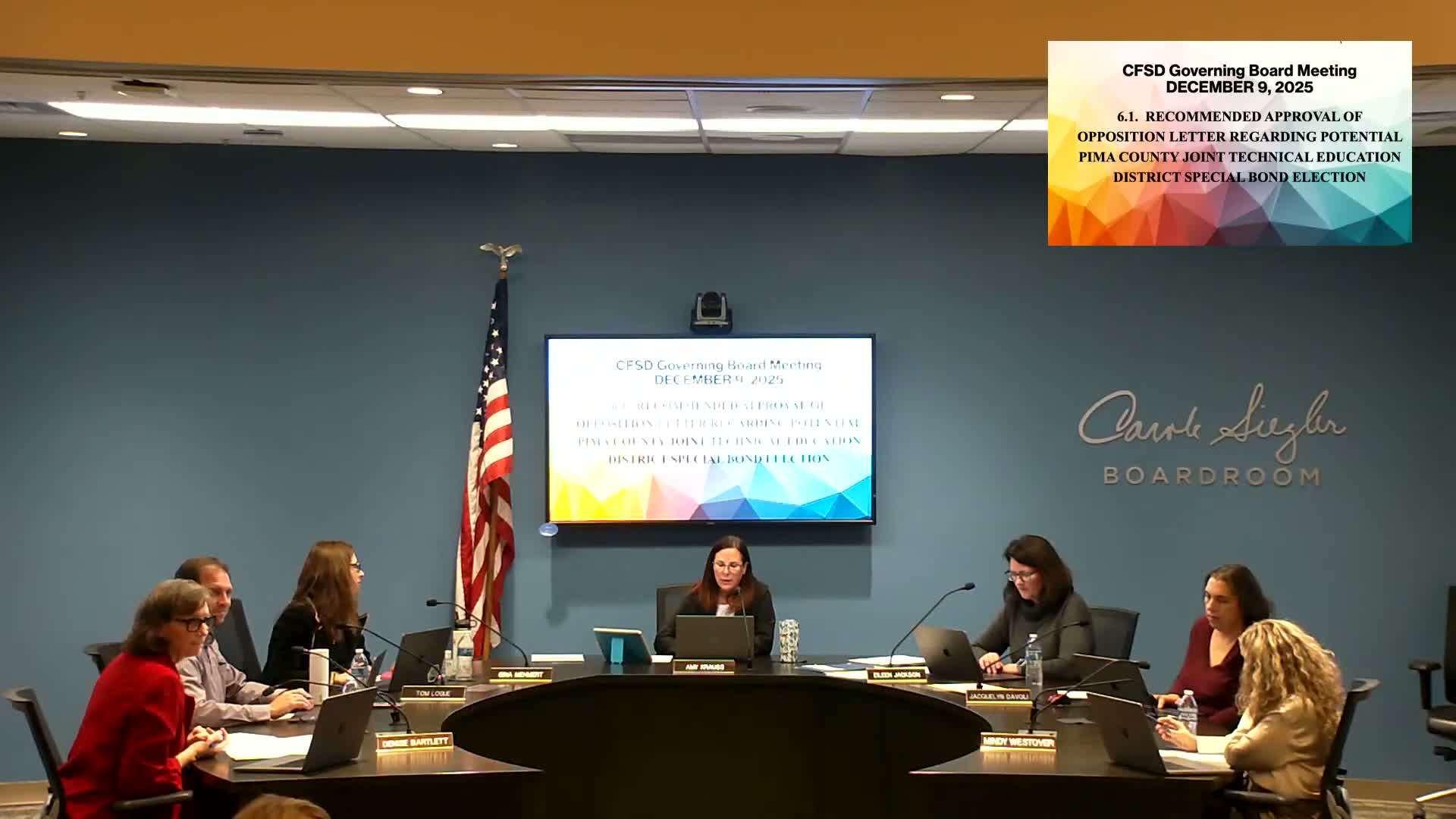
Summary
The Catalina Foothills Unified School District governing board voted 5–0 to sign a letter opposing the current draft of a proposed Pima County JTED special bond election, saying the plan would concentrate roughly $240 million on central campuses while leaving satellite programs—used by about 90% of students—significantly underfunded.
The Catalina Foothills Unified School District governing board voted 5–0 to sign a letter opposing the current draft of a proposed Pima County Joint Technical Education District special bond election, citing concerns that the plan would concentrate most capital spending at central campuses while shortchanging satellite programs that serve the majority of students. The motion approved on the board floor said the letter opposes the "current draft" of a potential bond slated for November 2026 and left open the possibility of reconsideration if new, substantive information is provided.
Dr. Denise Bartlett, the district superintendent, told the board administrators from Pima JTED proposed calling a special bond election for $300,000,000 and that, in the draft scenario she reviewed, roughly $240,000,000 of that total would be directed to central campus projects. "The proposed bond would disproportionately invest in central campus programs, and expansions at the expense of decentralized satellite programs," Bartlett told the board, adding that satellite programs "serve the vast majority of students in the JTED program." She said member-district superintendents in attendance at the initial meeting expressed unanimous concern about the draft's planning process and distribution of funds.
Board members pointed to enrollment and funding figures presented by Bartlett to explain their opposition. Bartlett described satellite participation as roughly 90% of Pima JTED students and said the draft's allocation produces a glaring per-student disparity: roughly $75,000 in bond funding per central-campus student compared with about $2,083 per satellite student. One board member called that a "staggering and indefensible discrepancy." Administrators also said there is no clear, published plan yet for how a proposed $60,000,000 intended for satellite districts would be divided among member districts.
Board members repeatedly questioned details that were not yet available: what the proposed new buildings would specifically house, why a central campus might be relocated farther from some member districts, how the bond timeline and permitting would proceed, and how the tax impact was modeled. Bartlett and district staff said they had not seen a community-driven plan or a complete timeline; she reported a rough tax estimate of about $15 for every $100,000 of assessed valuation if the bond were approved as described.
After discussion, the board approved a motion to sign the opposition letter to the Pima JTED board and administration. The motion passed 5–0. The board recorded that the vote reflected its judgment based on the information before it and left room to revisit the position if more detailed planning or different allocations are presented by JTED.
What happens next: The signed letter will be presented to the Pima JTED superintendent and governing board. The district did not set a further formal deadline for reconsideration; any future change would depend on new information or revisions to the bond draft.