Neighbors and experts urge denial of Rocky Brook PUD; planning commission sends negative recommendation
Loading...
Summary
After a lengthy public hearing, the Opelika Planning Commission recommended that city council deny rezoning about 239 acres around Rocky Brook from R-1 to a Planned Unit Development, citing wetlands, watershed protection, traffic and neighborhood incompatibility.
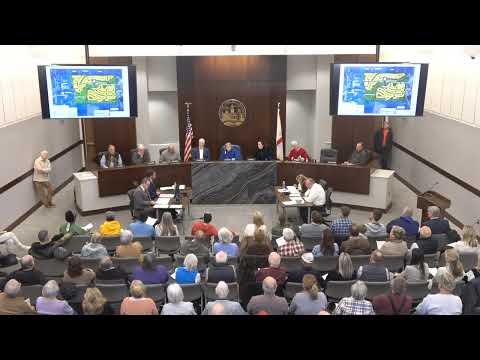
The Opelika Planning Commission voted to send a negative recommendation to city council on a proposed rezoning that would allow a Planned Unit Development on roughly 239 acres around Rocky Brook and Hillflow Avenue.
Staff introduced the annexation and associated rezoning proposal as a request from J and J Development LLC / Patriot Development Group; the applicant proposed a cluster-style PUD with up to 370–400 single-family units made up of lots roughly 7,500 square feet in size. Staff recommended against the rezoning, noting a mismatch between proposed lot sizes and the surrounding neighborhood and citing Saugahatchee Watershed protections that limit density in the critical watershed area.
Residents and technical experts spoke against the rezoning during a public hearing. Jeff Tickle, a nearby homeowner, said construction would strip upland vegetation, increase impervious surface and runoff, and accelerate sediment and pollutant flows into the watershed that feeds the city’s water supply. “The lot the houses take up the majority of the lot…makes that impervious,” Tickle said, warning of increased siltation and safety problems on Rocky Brook Road.
Michael Collier, a licensed professional engineer, told commissioners the application understates buildable land and therefore underreports density: he said roughly 94 acres of the site are wetlands and, when excluded, the actual density would rise to about 2.75–2.85 units per buildable acre — higher than surrounding R-2 areas. Collier also flagged an error on the developer’s title block listing “Opelika Lee County, Georgia” and said multiple PUD criteria in section 8.18 of the city ordinance appear unmet.
Other speakers — including an Auburn University biologist, adjacent property owners and longtime residents — raised common concerns about traffic on local two-lane roads, impacts on Morris Avenue School pick-up and drop-off, and long-term damage to wetlands and the city lake. Mac Morris, who said he grew up near the site, asked the commission to protect possible historic burial locations and an 180‑year‑old magnolia on the property.
After the hearing, the commission closed public comment and a commissioner moved to send a negative recommendation to city council on rezoning the parcel from R-1 to PUD. The motion carried on a voice vote.
What’s next: the planning commission’s recommendation will be transmitted to Opelika City Council, which will take the final action. The commission’s staff report and public comments will be part of the council record.