
County approves administrative-code change moving Criminal Justice Commission under Public Safety; board requests six‑month report
Get AI-powered insights, summaries, and transcripts
Subscribe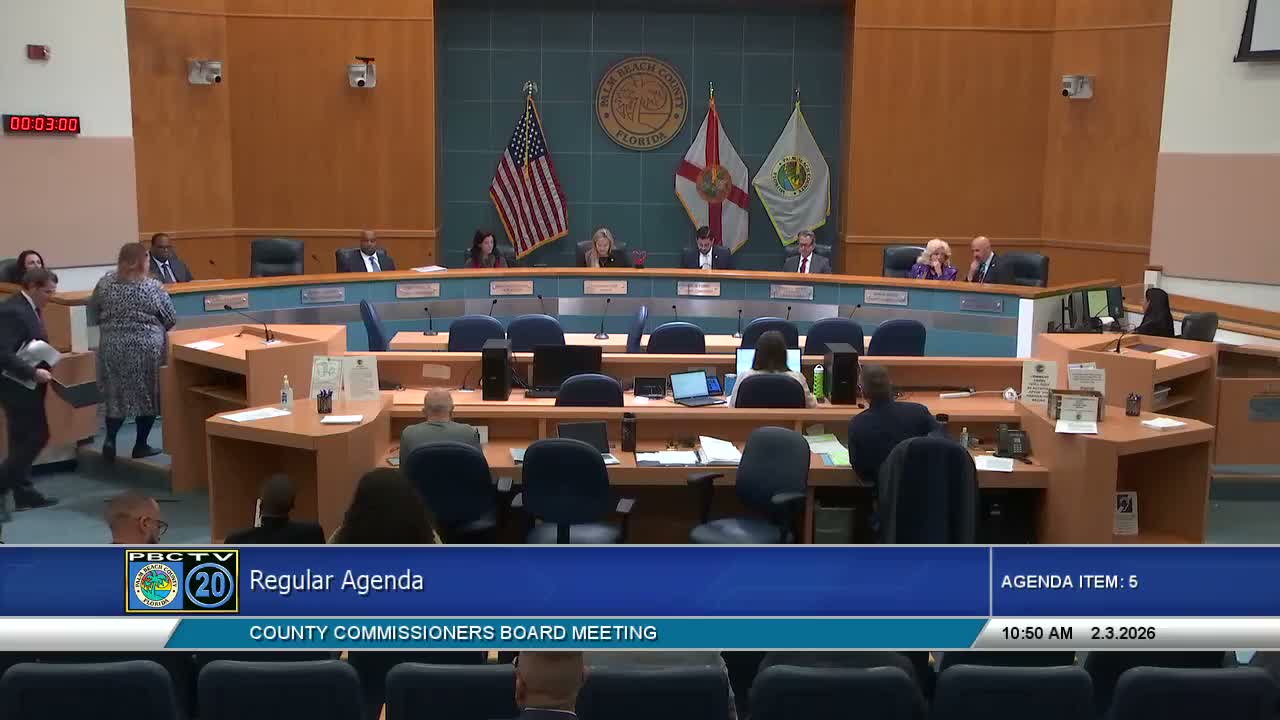
Summary
The Board of County Commissioners voted 7-0 to adopt an administrative-code resolution that restructures department reporting and places the Criminal Justice Commission under public safety oversight; commissioners and CJC members sought assurances that the commission’s advisory independence will be preserved.
Palm Beach County commissioners approved a resolution to amend the county’s administrative code that included several housekeeping changes and an operational shift to place the Criminal Justice Commission (CJC) under the Public Safety vertical.
Administrator Todd Nadler introduced the amendment as a set of administrative cleanups and clarifications including departmental namings and an adjustment to the administrator’s grant-execution threshold. A public speaker, Oswald Newbold — who identified himself as a member of the CJC executive committee — warned that reclassifying the CJC as a division under a department could undermine its independence. “If you move the CJC into public safety…what happens then is no longer autonomous,” Newbold said.
Michelle Suskower, chair of the Criminal Justice Commission and an attorney who said she has practiced in Palm Beach County for 34 years, told the board the CJC has a broad, multi-stakeholder membership and that she supports maintaining the commission’s independence. “As long as we maintain our independence, I feel that there's no issue with it,” Suskower said.
Administrator Abruzzo and deputy administrator Tom Nadler said the change is primarily operational: public safety already manages grant and financial oversight for the CJC, and adding a reporting layer would not change the commission’s advisory agenda-setting. Administrator Abruzzo told commissioners, “Public safety does not drive the agenda of the CJC… The board drives the agenda of the CJC.” Commissioners sought additional safeguards and asked that the CJC return in six months to report on how the changes are working.
Commissioner Flores moved to adopt the administrative-code resolution; Commissioner Marino seconded. The board approved the measure 7-0 and requested a follow-up report from the CJC in six months to assess any impacts on independence and operations.
What happens next: The administrative-code changes take effect as adopted; staff will continue to manage grants and operations under the new reporting structure and the Criminal Justice Commission agreed to return to the board in six months to report on the transition and any operational effects.