
Iroquois County ZBA recommends Lewis Creek solar project to county board with drainage conditions
Get AI-powered insights, summaries, and transcripts
Subscribe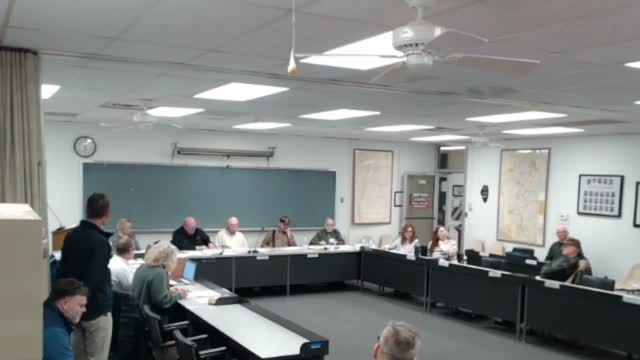
Summary
After a remand hearing limited to drainage, equipment manufacturers and a buffer variance, the Iroquois County Zoning Board of Appeals voted to recommend approval of the Lewis Creek (Allium) solar conditional-use permit to the county board subject to enforceable drainage and mitigation conditions proposed by the drainage district.
The Iroquois County Zoning Board of Appeals on Jan. 28 voted to forward a recommendation of approval to the county board for the Lewis Creek commercial solar project, but only after extracting new commitments on drainage protections and related conditions.
At a remand hearing limited by the county board to three issues—surface and subsurface drainage, identification of equipment manufacturers, and the requested alternative to a vegetative living buffer—applicants from Allium Renewable Energy presented supplemental mapping, a Westwood drainage memorandum and field-verified drain-tile surveys. Applicant representative David Driscom introduced the team and a slide packet the board admitted into evidence.
Jeffrey Carroll, who testified for the applicant, told the board the applicant’s consultants mapped the watershed and drain tile network and reported "there are a total of 685 acres of drainage that discharged into the site," and that roughly 383 acres of the project area drain offsite. Carroll said the company had shifted substation and battery locations to avoid the main district tile, had field-verified dozens of tile locations by trenching, and planned a mix of rerouting, capping and repair for tiles that could be affected by construction.
Nearby landowners and the Artesia Mutual Drainage District pressed for stronger remedies. Anita Reichert, a district member and adjacent landowner, urged the board to require a perimeter tile—"the gold star standard"—to prevent silt from on-site work flowing into the district main and causing failure. Don Wautier, an engineer retained by a contractor, and Don Lochier, the drainage-district engineer, recommended enforceable contractual protections. Lochier asked that the development agreement and the state Agricultural Impact Mitigation Agreement (AIMA) be made enforceable by the county, that the applicant submit a county-reviewable stormwater pollution prevention plan, and that the district’s main tile be television-inspected after construction.
The zoning board’s supplemental findings incorporated the new evidence and exhibits admitted at the hearing and the testimony outlining the drainage issues. After discussion, members moved to recommend approval of the conditional-use permit to the county board "subject to the recommended conditions" (the drainage-district conditions submitted into the record). A roll-call vote carried the motion; the board then closed evidence on the remanded items.
The board’s action is a recommendation only; the county board will take the final decision and may alter conditions. The ZBA pointedly asked that the development agreement include specific, enforceable steps for identifying and protecting mutual and district tiles during design and construction, and signaled it expects the applicant and drainage district to finalize an agreement before major construction activity.
Next steps: the ZBA forwarded its recommendation, the applicant is expected to work with the Artesia Mutual Drainage District on a written development agreement and design-level drainage plans, and the county board will receive the ZBA recommendation for final action.