Iroquois County residents press officials over drainage, decommissioning as large solar projects advance
Loading...
Summary
Residents and drainage-district representatives told the Iroquois County Planning & Zoning Committee Feb. 3 they fear driven piles for large solar projects will damage subsurface drain tile and increase flooding, and urged stronger requirements for drainage agreements and full decommissioning funds; developers say they have revised plans and are working with the drainage district.
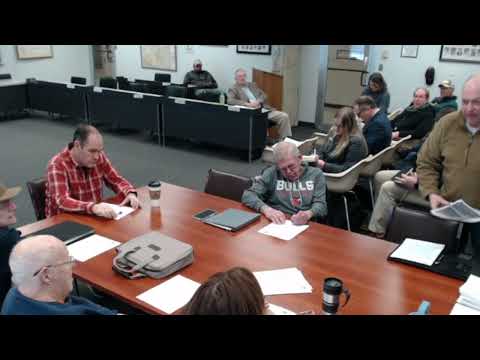
Residents, drainage-district engineers and county staff spent much of a Feb. 3 Iroquois County Planning & Zoning Committee meeting urging stronger protections for farmland and drainage ahead of two large commercial solar projects.
Several neighbors who live near proposed Ranger Power and Lewis Creek sites told the committee they fear post-driven solar racking will puncture existing subsurface drainage tile and aggravate flooding. "If they pound the tile, they're not gonna find all the tile," an unidentified resident said during public comment, adding that tile damage could lead to siltation, plugged drains and expanded flood risk for nearby properties.
Anthony Chubb, who identified himself as the tenant and caretaker of land north of the Lewis Street site, presented aerial maps and said surface water currently flows north into a pond and then into a tile that discharges to Lewis Creek. "If the land to the south is covered with solar panels, those are impervious surfaces…that'll cause more flooding, which also puts a greater severity of impact on Lewis Creek over Route 45," Chubb said.
Dawn Wathier, an agricultural and biological engineer with Burns Clancy & Associates retained by the Artesian Mutual Drainage District, told the committee the drainage can be handled "if done correctly," but recommended the county adopt conditions that give it clearer enforcement rights under zoning, require surface-grading plans and bind developers to specific protective actions with the drainage district.
Local landowners and drainage advocates urged more prescriptive surveys than the aerial-method proposals some developers have offered. Committee staff and legal counsel acknowledged aerial tile-mapping can undercount tiles on reclaimed or historically tiled farmland and proposed language that would permit more detailed, county-approved trenching or probing surveys in targeted areas.
Residents also raised related concerns: battery-storage siting in low-lying, periodically flooded ground; long-term maintenance of vegetation inside large arrays; spray/drift and snow-drift issues at road edges; and potential changes to farmland tax assessments if land is treated as commercial. County staff repeatedly noted that state law constrains some local authority — for example, statutes control how decommissioning financial assurances are phased — but officials said the county could still craft permit conditions and require agreements with the drainage district at the building-permit stage.
Developers pushed back that they have revised plans after the zoning-board of appeals process and have engaged the drainage district. Jesse Hopkins, chief telecom officer for Allium Renewable Energy and the representative for Blues Creek Solar, told the committee the project team has met with local drainage officials, made design changes and expects tax revenue and jobs: "Project will have a great impact to the community — $8 to $9 million in new tax revenues, about 100 jobs during construction and 4 to 5 long-term jobs," he said.
Committee discussion focused on two areas where local policy can add protections: (1) requiring a county-approved drain-tile survey (with the option for additional trenching/probing where aerial methods are insufficient) before construction activity begins in identified high-risk areas; and (2) tightening decommissioning assurances or choosing more secure financial instruments (bond or letter of credit) at defined permit milestones. Staff also proposed conditioning more detailed landscape or vegetative management plans to be reviewed at the building-permit stage.
The committee did not adopt an immediate ban or new ordinance at the meeting; instead, members voted to forward the two projects and related recommended conditions to the county's Policy & Procedure Committee for further drafting and review. The committee's next steps include drafting the specific permit language for board consideration and confirming what enforcement mechanisms the county can lawfully require under Illinois statutes.
What happens next: Committee staff said they will prepare proposed language addressing tile-survey methods, drainage-district agreements and options for stronger financial assurances, and the matter will return to the Policy & Procedure Committee and later to the full county board for final action.