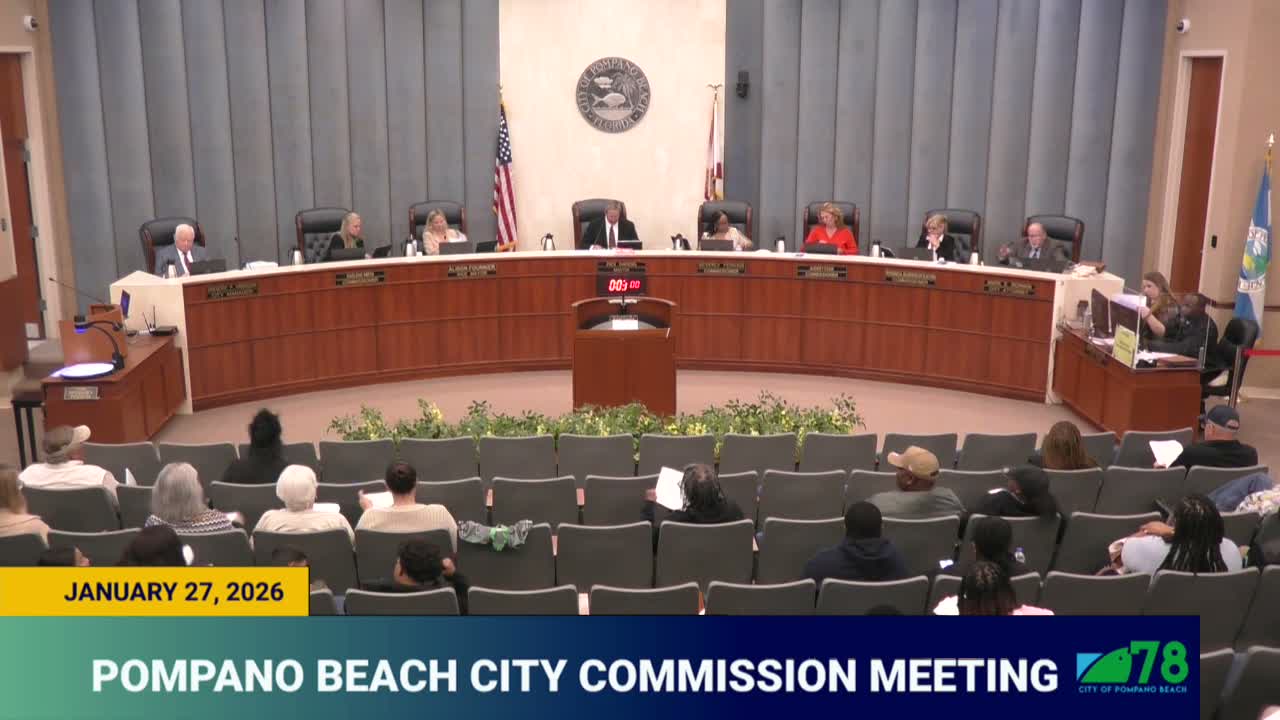
Pompano Beach approves zoning change to allow hospital‑affiliated off‑campus emergency rooms after heated public hearing
Loading...
Summary
The City Commission on Jan. 27 approved a privately initiated zoning text amendment to add a new category for hospital‑affiliated off‑campus emergency departments (freestanding ERs), 4–2, after hours of public comment and debate over neighborhood impacts, buffers, and the city’s review role.
POMPANO BEACH — The City Commission approved a citywide zoning text amendment Tuesday that creates a new land‑use category for hospital‑affiliated off‑campus emergency departments, commonly called freestanding emergency rooms, after a lengthy public hearing and a divided vote.
The ordinance, described by staff as an amendment to section 155.4209 of the Pompano Beach zoning code, cleared second reading by a 4–2 roll call vote. Commissioners Perkins, Sigerson/Eaton, Smith and Mayor Harton voted yes; Commissioners Fessett and Vice Mayor Fournier voted no.
Jean Dolan, Development Services, introduced the item as the second reading and said there had been no changes since the first reading and that staff and the applicant were available for questions. Dozens of residents and stakeholders then spoke for and against the text amendment at the commission’s 6 p.m. meeting.
Supporters — including parents, coaches and some residents — argued a freestanding ER would provide quicker access to emergency care for children and seniors. James Scott, a youth‑sports organizer, said such facilities can reduce wait times: “This type of facility has a wait time of 5 to 10 minutes to see a certified emergency doctor,” he told the commission. Patrick Bartholomew, speaking for a church congregation, said his community needed more access to health care options and urged commissioners to approve the change.
Opponents pressed the commission on process, neighborhood impacts and precedent. Multiple speakers noted the Planning & Zoning Board voted 6–1 against the measure. Residents who live near the proposed site said the parcel is too small, raised concerns about traffic and parking, and warned that a citywide change could allow similar uses next to homes. “If this passes, a 24‑hour emergency room can be approved automatically with no planning and zoning review and no public input,” Melissa Weekley said, urging a no vote.
Parks and Recreation Director Scott Moore told the commission he had not been notified of any plan to move youth sports programs and asked to meet with coaches after public concerns about relocations surfaced earlier in the meeting.
Commission debate focused on two central questions: whether the city should create a specific regulatory category for freestanding emergency rooms, and whether the privately proposed draft struck the right balance between access to care and neighborhood protections. Commissioners opposed to the amendment said the draft removed too many neighborhood review opportunities and set a bad precedent. Those in favor said the city lacked an appropriate code category for a new facility type and that the draft added acreage and buffer standards to limit proliferation.
Commissioners also discussed technical details in the draft: staff said the ordinance added a minimum parcel size (proposed by the applicant), buffering requirements, and other conditions intended to limit proliferation; commissioners noted the zoning change would not automatically place ambulances on small side streets and that ambulances typically would travel on main roads.
Outcome and next steps: The commission approved the second reading and adopted the text amendment. The ordinance is a change to the city’s zoning code (no ordinance number specified in the public transcript). The adopted text will allow freestanding, hospital‑affiliated emergency departments to be permitted in qualifying commercial zoning designations subject to the ordinance standards and site planning requirements. Where the amendment applies and its exact implementation details will be determined through site planning processes and future staff actions.
What remains unresolved: Several residents and commissioners asked for more study on siting, parking, ambulance routing and whether a city call‑up or special‑exception review option should exist for controversial sites. The Planning & Zoning Board’s recommendation against the change and the split commission vote signal continuing local disagreement. The commission did not specify an immediate implementation timetable in the public record.
The commission recessed for 10 minutes after the roll call and then continued with the remainder of the agenda.