Get Full Government Meeting Transcripts, Videos, & Alerts Forever!
Get email alerts on the Land Use topic
No spam. Unsubscribe anytime.
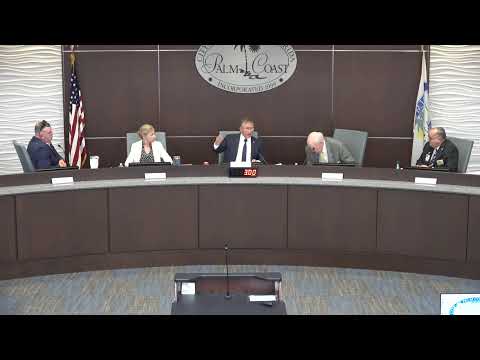
Palm Coast council approves first reading for East Hampton MPD amendment amid resident objections
Summary
ICI Homes asked the council to amend a 2012 settlement allowing 58 residential entitlements, seeking 13 more units by reducing lot sizes and setbacks. Council approved first reading 3–2 after extensive public comment about flooding, traffic and property values; staff said utilities and traffic impacts are minimal and a public-benefit package could be negotiated before second reading.
The Palm Coast City Council voted 3–2 on Feb. 3 to approve the first reading of an amendment to the East Hampton master plan development (MPD), a requested change that would increase residential entitlements on the site from 58 to 71 lots. The application, filed by CP and HE Residential Lots LLC (a subsidiary of ICI Homes), asks the city to modify a prior settlement and recorded MPD to shrink internal minimum lot area from 8,250 square feet to 5,500 square feet and reduce some setbacks (side yard from 7.5 feet to 5 feet; street-side from 15 feet to 10 feet).
City planning staff told the council the submission includes the analyses the Land Development Code requires and that the increase of 13 units produces a “very minor” net traffic effect and marginal water/wastewater demand. Michael Hanson of Community Development told the council the waste-water system had capacity and that the additional 13 homes would add roughly 3,000 gallons per day of water use and about 2,000 gallons per day of wastewater — figures staff characterized as minimal against current plant averages.
Why it matters: residents who live adjacent to the project said the change would alter the character and livability of the long-noted East Section neighborhood. Dozens of neighbors urged denial during the hearing, citing existing flooding and drainage problems, single egress concerns, possible property-value impacts and the planning board’s unanimous recommendation to deny. At the December planning-board hearing staff abstained from a recommendation because the amendment also requires modifying a prior settlement agreement reached in litigation and recorded with the MPD.
The developer said the amendment does not expand the development footprint or usable land but rather shifts lot lines so the project can be economically viable while still protecting wetlands and providing a 25-foot perimeter landscape buffer that remains in place. ICI representatives said the smaller lots are intended to produce housing price points they can build sustainably on the site; they also offered to work on community benefits (sidewalks, lift-station siting, deeded easement to prohibit future road punch-through) during the interval between first and second reading.
Council reaction and next steps: some council members expressed concern about deviating from the LDC minimum lot-size norms; others said there was room to negotiate community benefits. Vice Mayor Pontieri and Council members Gambarro and Sullivan voted yes on first reading; Council members Miller and Mayor Norris voted no. If council proceeds, the MPD amendment will return for second reading and, if adopted, the applicant must still complete preliminary plat, technical site-plan reviews, stormwater and building-permit processes before construction. Staff noted that any approval could carry conditions — for example a recorded easement preventing future roadway connections — and that final platting and permit steps would require demonstration of compliance with the comprehensive plan and applicable codes.
What the city asked for: council members asked the applicant to consider a formalized public benefit commensurate with the requested additional 13 lots (examples discussed included sidewalks around the project lake, deeded non‑vehicular easement to prevent future road punches, lift station siting concessions, or other infrastructure investments) and to work with staff to ensure the site plan and stormwater provisions address local drainage concerns. The council explicitly directed staff and the applicant to develop the specifics in advance of the second reading.
The first-reading vote does not authorize construction; it advances the amendment through the legislative steps required by the MPD and the settlement language attached to the original approval. The matter returns to council for a second reading, public notice and final vote.