Get Full Government Meeting Transcripts, Videos, & Alerts Forever!
Get email alerts on the Waste Management topic
No spam. Unsubscribe anytime.
Ocala council rejects ordinance to allow permanent air‑curtain incinerators
Summary
After lengthy testimony from applicants, engineers and residents, the Ocala City Council voted down Ordinance 2026‑5, a proposed zoning change that would have authorized permanent above‑ground air curtain incinerators as an ancillary use to materials recovery facilities. The vote followed public safety and land‑use concerns from neighbors and consultants.
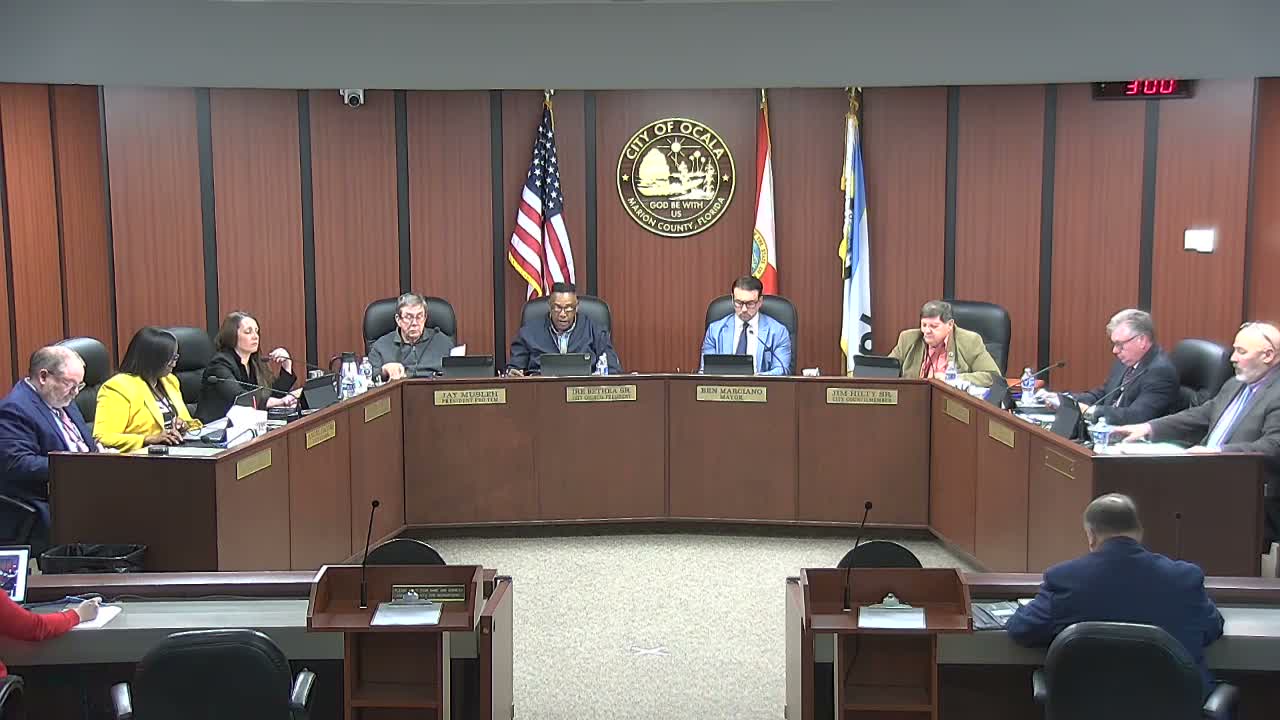
Ocala City Council on Feb. 3 rejected Ordinance 2026‑5, a citywide text amendment that would have allowed above‑ground air curtain incinerators to operate permanently as an ancillary use at materials recovery facilities. The motion to adopt the ordinance failed in roll call after extended presentations, technical testimony and public comment.
The ordinance, introduced for second reading by a council member, would have added a new subsection to chapter 122 of the city code permitting air curtain incinerators subject to operational requirements. Growth management staff described key provisions including restricted burnable materials, compliance with the most stringent federal/state/local standards, a minimum 10‑acre site requirement, minimum setbacks (200 feet from protected uses with an additional 100‑foot buffer added in amendments), a site plan and robust operations plan with annual compliance review, a log of daily authorizations, a 14‑day limit on stored debris and a 25‑foot cap on stockpile height. The ordinance also required annual review and gave the growth management director (the building official) authority to revoke approvals for noncompliance.
The applicant, represented by Fred Roberts, argued the change filled a regulatory gap. "It is environmentally sensitive. It is sustainable. It is clean," Roberts said, describing air curtain incinerators (ACIs) as engineered devices that limit visible smoke and reduce certain emissions compared with open pile burning. Engineer Austin Daly summarized studies from the U.S. Forest Service, Oregon and Arizona that, he said, found large ACIs produce substantial reductions in PM2.5 and carbon monoxide compared with open burning.
Opponents — including West Oak developers’ counsel Tim Haines, environmental consultant David Latham and local residents — urged the council to reject or substantially limit the proposal. Haines said there was "no evidence before you that these air curtain incinerators are safe or in any way appropriate adjacent to a residential neighborhood," and argued the use belongs under special‑use review or tied to C&D landfills rather than allowed by right in M‑zoning. Latham said FDEP typically advises against siting similar facilities in urban or suburban residential settings and warned of ash generation and potential contaminants in urban debris streams.
Fire‑safety oversight was a central point of discussion. Fire Marshal Clayton Anderson explained the daily ignition/permit requirement aligned with Florida Forestry Service practice and said the city would follow FFS guidance: some days will be no‑burn days depending on dispersion and weather. Fire Chief Clint Wilburn told council the department’s safety concerns about setbacks had been addressed in ordinance revisions and said the fire department had no remaining objections to the revised setback language.
Council members weighed land‑use compatibility with technical evidence and public concern. Several members said if the council were inclined to allow the use, they would prefer it come back as a special exception or be limited to C&D landfill operations rather than be permitted across all qualifying M‑zoned parcels. On roll call the ordinance received recorded "No" votes and thus failed to pass on second reading.
Next steps: Staff and the applicant may revise the ordinance and return with amendments or could seek a different permitting pathway (for example, tying the use to C&D landfills or requiring special exception review). The city will retain existing permitting channels for mobile burn permits under Florida Forestry Service guidance; the ordinance would have created a separate regulatory path for permanent, on‑site ACIs.
Sources: Staff presentation summarizing ordinance language; applicant presentations by Fred Roberts and Austin Daly; technical testimony from David Latham and others; public comments; and council roll call on Feb. 3, 2026.