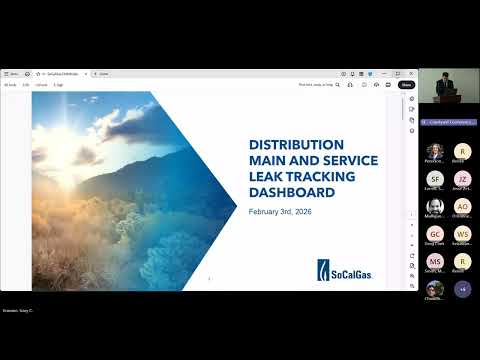
SoCalGas details leak-tracking dashboard and decision-tree pilot to speed repairs of potentially large leaks
Loading...
Summary
SoCalGas described a dashboard launched in 2023 that centralizes leak data, geocodes leaks into GIS, preserves repaired-leak history, and introduces a DT Plus decision tree to flag potentially large leaks with a pilot goal to repair those within 75 days.
Dan Kossain, an environmental-services manager at Southern California Gas Company, described a leak-tracking dashboard SoCalGas launched in 2023 that aggregates detection records, geocodes leaks for GIS display, and gives operating groups near‑real‑time visibility into leak status and aging inventories.
SoCalGas’s dashboard pulls data from the company’s central database and replaces the previous workflow of exported Excel spreadsheets. "This tool interfaces with the database and gives you the information like most of the time," Kossain said, noting users can quickly see when a leak was detected, its repair status and how long it has been open.
Kossain said the system retains records for fixed leaks so teams can review history and QA/QC prior repairs. He described integration between the dashboard and GIS that lets staff visualize leak density, drill down on clusters and identify infrastructure or capital-replacement needs.
SoCalGas is developing a DT Plus (decision-tree) feature that assigns codes for potentially larger leaks (PLL) based on survey measurements and other field points; PLLs would be prioritized for repair. Kossain said a beta is expected by the end of the second quarter and the company plans a pilot aiming to repair identified potentially larger leaks within 75 days. "We're going to set a goal where whenever we identify one of these potentially larger leaks, we're going to try to get that fixed in 75 days or less," Kossain said.
During Q&A attendees asked whether the dashboard estimates leaks in unsurveyed territory. SoCalGas staff said the dashboard focuses on actual leaks found by survey and that extrapolation of unsurveyed territory is done as part of the broader NGLA estimation program rather than in the operational dashboard. Attendees also asked about QA/QC timing and whether the public-facing leak map uses the same data feed; SoCalGas said district-level QA/QC occurs before entries are finalized in the dashboard and that the public map and dashboard draw from the same underlying data.
Why it matters: The dashboard centralizes operational leak data, helps prioritize higher‑emitting leaks, and may streamline permitting and repair workflows in coordination with municipalities.
The presentation closed with staff fielding additional questions and confirming plans for pilot rollout and follow-up correspondence.