Get Full Government Meeting Transcripts, Videos, & Alerts Forever!
Get email alerts on the Retirement Claims topic
No spam. Unsubscribe anytime.
TRS tells 2026 retirees to allow 60–90 days for claims and heed AAI deadline
Summary
Teachers' Retirement System officials told members retiring in 2026 to begin a personalized retirement interview 2–3 months before leaving, to expect 60–90 days of claim processing after all forms and payments arrive, and to meet the June 29, 2026 last-work-day cutoff to qualify for the AAI lump-sum offer.
Nick Stabler, outreach coordinator for the Teachers' Retirement System (TRS), told a Jan. 27, 2026 webinar that members should start a personalized retirement interview (PRI) two to three months before their planned retirement so TRS can verify demographics, beneficiaries and balances and pre-fill retirement forms.
Stabler said TRS staff will use the PRI to establish a retirement claim date — usually the day after a member's last day worked — and noted that the claim date can instead be a later eligibility date such as a birthday. "Once your forms are in and all balances are paid or reconciled to 0, claim processing begins," he said, adding, "claim processing takes 60 to 90 days." That 60–90-day clock starts when TRS receives the last required employer form or payment, he said.
The timeline matters because TRS issues retirees' first monthly pension retroactively once they are placed on payroll. Stabler explained that the first check is paid in arrears (for the previous month) and can include retroactive months depending on processing speed. TRS generally issues monthly payments on the first banking day of each month.
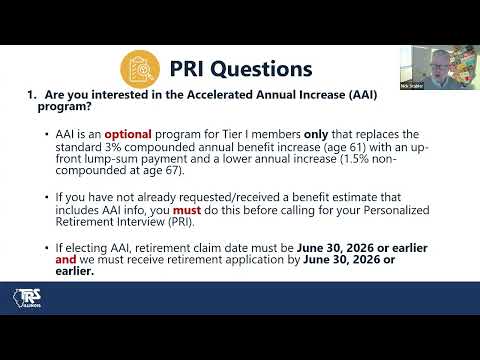
The webinar also explained the Accelerated Annual Increase (AAI) option for Tier 1 members. TRS will offer Tier 1 retirees an upfront lump sum in exchange for trading away future compounded annual cost-of-living increases. Stabler warned that the AAI election is irrevocable and that members should get an "AAI-inclusive" benefit estimate before deciding. He gave a firm logistical cutoff: to qualify for AAI, a member's last day worked must be no later than June 29, 2026; a signed retirement application with the AAI box checked and received before June 30, 2026 will be treated as a qualifying election.
TRS will mail a separate official AAI election form after a member's retirement claim is established; retirees choosing cash can have at least 20% withheld for taxes or roll the amount into a tax-sheltered plan. Stabler also said AAI and similar excess-contribution refunds are issued by paper check.
Stabler encouraged members to use the TRS online "claim tracker" in their myTRSIL account to see which member and employer forms have been received, what holds exist (including reciprocal-system holds), and when TRS expects to finalize payroll placement. He said the tracker was developed in response to member feedback and modeled on well-known parcel/restaurant tracking user interfaces.
What happens next: members who have not completed a PRI are advised to call TRS, verify contact information, and return wet-signed retirement forms promptly to start the 60–90-day processing period.