Get Full Government Meeting Transcripts, Videos, & Alerts Forever!
Get email alerts on the Land Development Code topic
No spam. Unsubscribe anytime.
Palm Coast staff outline revisions to Chapter 11 on tree protection, landscaping and irrigation
Summary
City staff presented a slate of proposed changes to Chapter 11 of Palm Coast's Land Development Code that clarify tree measurement, protection thresholds, mitigation formulas, buffer credits and irrigation requirements; no formal vote was taken and staff will refine language based on board feedback.
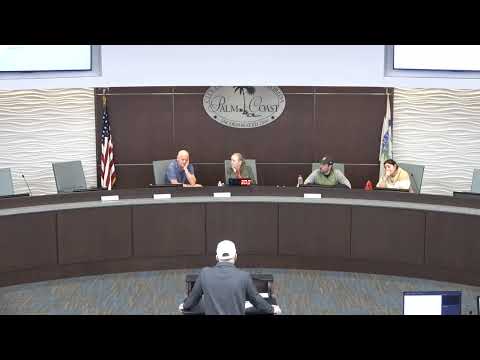
City staff presented proposed amendments to Chapter 11 of Palm Coast's Land Development Code at the Beautification and Environmental Advisory Board meeting on Jan. 22, saying changes aim to implement the comprehensive plan, clarify intent and address recurring implementation issues.
The draft would tighten measurement and protection rules and give staff clearer authority in some cases. Rick (staff presenter) said existing-tree diameter will be measured as DBH at 4 feet 6 inches, while new landscape trees would be measured at 6 inches above grade. The proposal also specifies that shade trees planted to meet minimum tree density must be at least 1.5 inches in caliper and retains the code's current density of one tree per 2,500 square feet.
Why it matters: the amendments change how the city counts and protects trees during development and set clearer mitigation and enforcement expectations. Under the draft, "protected" trees would be trees 6 inches and larger, "specimen" trees generally 24 inches and larger and "historic" trees 36 inches and larger, and each category would be treated separately for preservation and mitigation calculations.
Staff described mitigation rules tied to Table 11-4: removal of protected trees would be mitigated with shade-tree equivalents from the table; higher-caliper specimen and historic trees require multiple replacement trees (caliper math example: a 36-inch trunk divided by the 3.5-inch replacement size yields the number of required plants). Rick said mitigation costs fall to property owners and that planting replacement trees typically runs about $1,000 per tree.
The draft also clarifies survey and preservation practice: tree surveys can be done by an arborist, landscape architect or surveyor and typically identify trees 6 inches and larger; in large monoculture stands staff may sample density rather than catalog every individual pine.
Other substantive changes in the draft include: - Buffer and preservation credits for trees in wetlands, with limits on using the same preservation for multiple incentives. - Allowing the land use administrator to determine when site fill makes it infeasible to save protected/specimen/historic trees, shifting some determinations from developers to staff and prompting on-site assessments and, when necessary, arboricultural studies. - Up to 50% credit for qualifying existing pine trees toward buffer shade-tree requirements in large subdivision projects, with limits and a requirement to plant the balance. - A requirement that all irrigation systems include an operational moisture-sensing device or smart irrigation (for reuse or rain detection) to reduce potable-water use. - A 3-foot clearance for planting screens around mechanical equipment to preserve access for maintenance. - Strengthened as-built requirements: irrigation and landscape as-built drawings must be provided and certified with signed and sealed plans by a landscape architect before a certificate of occupancy for non-single-family/duplex/estate projects. - Mulch standards increased to 3–4 inches and pruning rules that require certified-arborist supervision for certain commercial/multi-family maintenance. - Expansion of the TreeBank Fund's allowable uses to include relocation, irrigation installation, mulching and agricultural practices to support long-term care of public trees.
Board members and staff discussed practical details and tradeoffs. Carol Minnie, the city urban forester, said the team plans to add illustrations to the technical manual to clarify measurements and common field situations: "we are looking at doing some illustrations that will go into the technical manual" to help people who are visual learners. Several builders and permitting representatives welcomed clearer definitions but pressed staff on whether minimum calipers should be increased to reduce tree loss during grading.
Staff cited recent project negotiations — including work to preserve oaks at a Palm Coast Parkway commercial site — as examples of the kind of on-site coordination they expect to continue. Rick said when feasible the city negotiates road or layout changes with applicants and, when necessary, performs arborist field studies to decide whether trees are healthy and worth preserving.
No formal action was taken on the Chapter 11 amendments at the meeting. Staff said they will present additional code chapters in the coming months and invited continued comments through Social Pinpoint and other outreach. The advisory board recorded several suggested wording clarifications and asked staff to return with refined language.