
Rep. Spilsbury’s HB 1,800 would convert swept tax to uniform statewide levy and raise base adequacy
Get AI-powered insights, summaries, and transcripts
Subscribe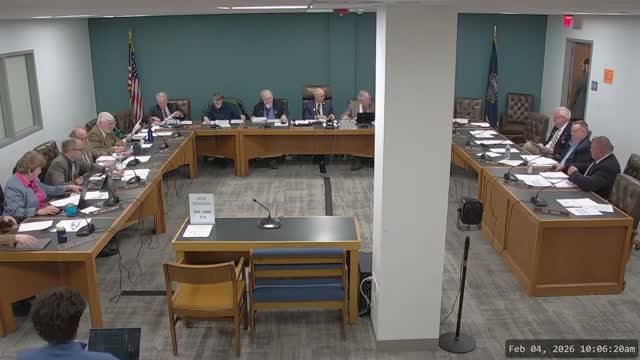
Summary
Representative Spilsbury told the House Ways and Means Committee HB 1,800 would turn the swept education property tax into a uniform statewide levy (proposed $5 per $1,000 of equalized value), remit swept receipts to the state, create homeowner exemptions, and raise base adequacy to $10,000 per student plus $4,000 for students eligible for free or reduced-price lunch; DRA and DOE urged technical fixes and recommended work sessions or interim study.
Representative Griffin Spilsbury (Representative) introduced HB 1,800 to the House Ways and Means Committee as a proposal to address wide disparities in property tax rates that fund public education by converting the swept education property tax into a true, uniform statewide levy.
Spilsbury said the bill would replace the current fixed swept figure with a rate-based approach — $5 per $1,000 of equalized value — so the first $5 of a taxpayer’s property tax would flow into a statewide education pool. He said the change is intended to make the swept tax transparent, adjust automatically with changes in property valuations, and restore the pre-2011 practice of sending swept receipts into a central pool rather than allowing some municipalities to retain excess swept funds.
The proposal would also raise the base adequacy payment to $10,000 per ADMR student and add $4,000 for each pupil eligible for free and reduced-price lunch. Spilsbury said the bill removes special education differentiated aid from the adequacy formula and intends to address special education funding in a separate, comprehensive revision. The bill would include a COLA for spending-side allowances and three percentage exemptions (described in the bill as credits): 20% for primary-residence homeowners, 10% for households with no school-age children, and 10% for taxpayers 65 and older; Spilsbury said the credits would be cumulative.
Mark Manganiello of the Department of Education’s Bureau of School Finance told the committee the bill contains technical drafting issues that make it difficult to run a reliable adequacy spreadsheet. He referred the committee to the statutory adequacy algorithm (statutes cited in testimony) and said many of the sponsor’s intended changes live in different parts of law than the bill amends, which risks producing outcomes other than those intended. Manganiello’s preliminary arithmetic — using the sponsor’s assumptions — showed state expenditures could rise substantially and that some communities now considered "donor" towns could end up paying more than they receive under the new formula.
Lauren O’Sullivan, a senior financial analyst at the Department of Revenue Administration (DRA), outlined implementation hurdles: possible confusion over whether equalized or straight assessed value is used, the need to involve the Treasury for final distributions, administrative burdens on local tax offices to collect and report exemption eligibility, portal modifications at the DRA, and an estimated $350,000 appropriation to modify DRA systems to implement the bill’s reporting and calculation requirements.
Committee members asked multiple technical and policy questions. Some members said the proposal could bring stability to small, rural districts; others warned that retaining full local taxing authority could allow localities to offset any state redistribution by raising local levies. Spilsbury repeatedly described the bill as a discussion piece and urged the committee to schedule detailed work sessions and to consider joint study with the Education Funding Committee or an interim study to resolve statutory, administrative and fiscal questions.
The chair closed the public hearing on HB 1,800 after committee members and agency representatives recommended further modeling and drafting work.
Next steps: committee members and staff signaled support for a work session or interim study to build compatible spreadsheets and statutory text, align the adequacy algorithm with the bill’s distribution rules, and refine implementation mechanics before any committee recommendation.