
Board endorses three‑year contract to raise teacher pay across three years; year‑one cost ~$765,708
Get AI-powered insights, summaries, and transcripts
Subscribe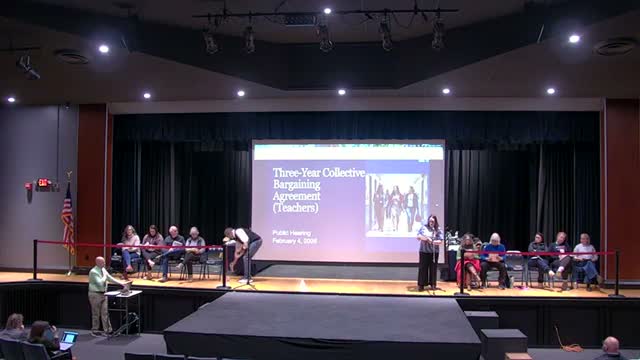
Summary
The board approved Article 5, a three‑year collective bargaining agreement with the Merrimack Valley Education Association aimed at improving starting salaries and retention; estimated additional costs are $765,708 in year one, $692,098 in year two, and $667,602 in year three (total presented ~ $2,125,408).
The Merrimack Valley School Board voted to approve a three‑year collective bargaining agreement with the Merrimack Valley Education Association, which negotiators described as intended to make district teacher pay more competitive and to improve retention.
Jessica Wheeler Russell, identified earlier as chair of the district negotiating committee, presented Article 5 and summarized the financial structure. She said the estimated additional cost for the 2026–27 school year is $765,708 (broken down in the presentation as approximately $603,490 in salaries, $116,051 in retirement contributions and $46,167 for FICA/payroll tax). For 2027–28 she listed an estimated increase of $692,098 (about $545,474 salaries, $104,895 retirement and $41,729 FICA), and for 2028–29 an estimated $667,602 (about $526,168 salaries, $101,182 retirement and $40,252 FICA). The three‑year total presented in the meeting sums to roughly $2,125,408 when those annual figures are added.
Russell also described several non‑financial contract changes included in negotiations: an additional professional development day for staff, conversion of sick‑time language into a paid‑time‑off model, K‑12 coverage alignment to standardize coverage language, pay for elementary teachers for pre‑school classroom setup, and new liquidated‑damages language to deter mid‑year contract breaches.
Public commenters generally expressed support for teachers but asked that professional development days not leave classrooms with low‑quality substitute work; negotiators and administrators said the non‑financial terms were discussed during bargaining and clarified how liquidated damages and coverage alignment will operate.
The board moved and approved Article 5 by voice vote; the transcript shows no recorded opposition. Implementation will be coordinated by the SAU human resources and payroll offices and the additional costs will be incorporated into upcoming fiscal-year accounting.